
Mitral Valve Repair: Left Ventricular Function Impact
pp 659-664
DOI:
https://doi.org/10.7775/rac.v65i6.3800Keywords:
Mitral valve repair, Ventricle functionAbstract
Background
Compared with mitral valve replacement, patients with mitral valve repair have better postoperative outcome. The aim of this study is to analize, in two groups of patients, the baseline characteristics, longterm follow up and echocardiographic assessment of left ventricular function.
Method
Between October 1992 and June 1994, 46 patients underwent mitral valve surgery due to mitral organic insufficiency. All patients included in this report hada preoperative and postoperative (follow up) echocardiogram. Group A: mitral valve repair, 26 patients, and group B: mitral valve replacement, 20 patients.
Results
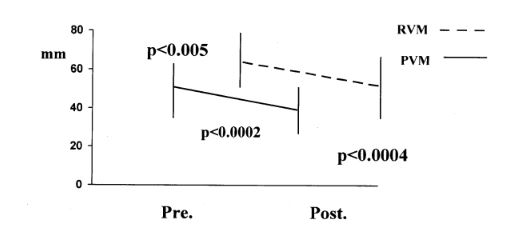
The group of patients with mitral valve repair (group A) had better baseline characteristics: functional class I-II (p < 0.04), atrial fibrillation (p<0.01), end diastolic diameter (p< 0.07), end systolic diameter(p < 0.003), ejection fraction (p< 0.001), left atrium diameter (p < 0.01). Univariate analysis showed that variables like: preoperative ejection fraction (<0.001), preoperative end systolic diameter (p < 0.003), difference end systolic diameter (p< 0.0005) and difference ejection fraction (p< 0.00001) reached statistical significance. Multivariate analysis indicated an independent benefit on postoperative ejection fraction (p<0.004) for the group of patients with mitral valve repair. Data for end systolic diameter reached also statistical significance (p< 0.07). There were no episodes of endocarditis, thromboembolism and reoperation in the group of patients with mitral repair and the hospital mortality was 1/26. In group B, one patient presented endocarditis and needed reoperation, another patient had a thromboembolism and hospital mortality was 2/20.
Conclusions
a) Patients with mitral valve repair were in better conditions before surgery, with low incidence of atrial fibrillation and better functional class. b) Left ventricle function was better preserved in mitral repair group. c) Low operative mortality with valve repair and the possibility to be free of anticoagulation are incentives for early surgical treatment.
Downloads
Published
Issue
Section
License
Copyright (c) 2026 Argentine Journal of Cardiology

This work is licensed under a Creative Commons Attribution-NonCommercial-ShareAlike 4.0 International License.





