
Age-Related Changes of Cardiac Caveolins and Nitric Oxide Synthase Modulation during Hypovolemic State
pp. 487-492
DOI:
https://doi.org/10.7775/rac.v79i6.1965Keywords:
Bleeding, Nitric Oxide, Left VentricleAbstract
Background
Nitric Oxide (NO) is one of the factors activated by hypovolemic state. Caveolins might affect the production of NO with increasing age.
Objective
To investigate the interaction between caveolin-1 (cav-1) and endothelial nitric oxide synthase (eNOS) in the ventricles of young and adult rats subjected to acute bleeding.
Material and Methods
We used young (2 months old) and adult (12 months old) male Sprague-Dawley rats. The animals from each age group (young and adult) were divided into two experimental groups: Control: control group, and Hem: bleeding group (20% of blood volume). The animals were sacrificed and the left ventricle was resected.
Results
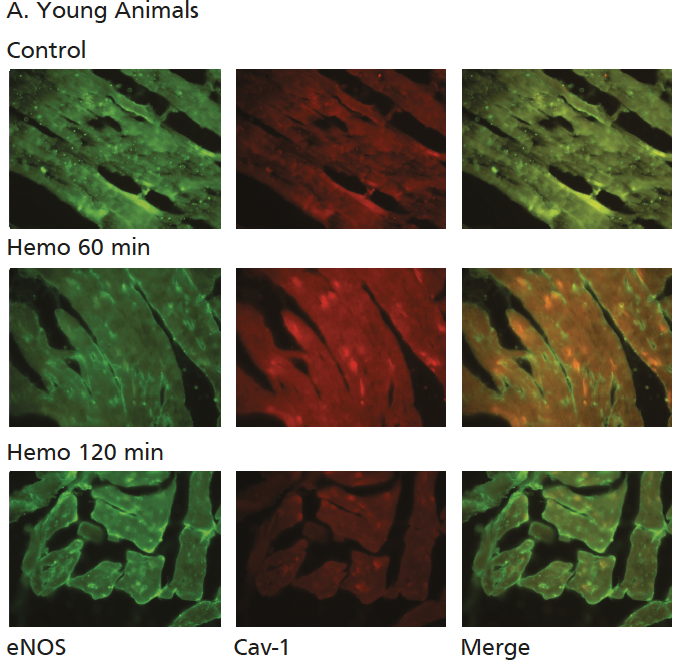
After bleeding, NOS activity increased by 21% and 45% in young rats and by 32% and 56% in adult rats. Western blot analysis revealed that NOS levels were lower (31%) in adult rats. Sixty minutes after bleeding, eNOS activity increased by 147% in young animals and by 66% in adults, with lower increase at 120 minutes. Colocalization showed a diffuse pattern of eNOS location associated with cav-1 in group Control of young animals. A dissociation pattern was observed in group Hem at 60 min which was partially restored at 120 min. The dissociation pattern of eNOS and cav-1 in group Control adult animals was greater compared to that of young rats. This characteristic was also seen after 60 min and 120 min.
Conclusions
The increased production of NO during hypovolemic state depends on the presence of cav-1 which plays a key role in the aging process.
Downloads
Published
Issue
Section
License
Copyright (c) 2025 Argentine Journal of Cardiology

This work is licensed under a Creative Commons Attribution-NonCommercial-ShareAlike 4.0 International License.





