
Towards the Elucidation of the Role of the Chloride Anion in Arterial Hypertension: Its Link with Oxidative Damage in the Kidney
pp 96-104
DOI:
https://doi.org/10.7775/rac.es.v89.i2.20034Keywords:
Cloruro, Hipertensión, Kidney, Lipid Peroxidation, Glutathione PeroxidaseAbstract
Background: The role of the chloride anion on the deleterious effects of excessive salt (NaCl) intake is unknown and whether its effects are independent of the presence of sodium.
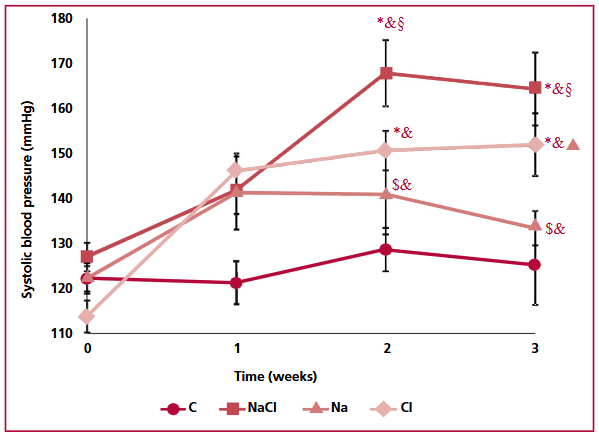
Objective: The aim of this study was to demonstrate that both chloride and sodium overload in the diet produce independent deleterious effects on systolic blood pressure (SBP), renal function and kidney markers of oxidative stress.
Methods: Male Wistar rats were divided into four groups (n=8/group) and fed different diets for three weeks: C: control (standard diet), NaCl: high sodium-high chloride diet; Na: high sodium without chloride diet and Cl: high chloride without sodium diet. Systolic blood pressure (SBP) and renal function were measured, and thiobarbituric acid reactive species (TBARS) production, and superoxide dismutase (SOD), catalase (CAT) and glutathione peroxidase (GPx) enzymatic activity and expression were evaluated in the renal cortical tissue.
Results: After three weeks, SBP increased (*) in the two groups fed with chloride. Fractional excretion of sodium and chloride increased (*) in the NaCl and Na groups. Diuresis and TBARS increased (*) in the renal cortex with the three diets, with no changes in SOD and CAT activity and expression. GPx activity increased (*) in the two groups that received chloride (* p <0.05 vs. C).
Conclusions: Both sodium and chloride overload are associated with a higher oxidative state characterized by increased lipid peroxidation in the renal cortex. However, only chloride overload is associated with higher GPx activity and hypertension without changes in urinary chloride excretion, suggesting a higher renal pro-oxidant state in this experimental group with respect to the Na group.
Downloads
Published
Issue
Section
License
Copyright (c) 2025 Argentine Journal of Cardiology

This work is licensed under a Creative Commons Attribution-NonCommercial-ShareAlike 4.0 International License.





