
Epicardial Fat and Hepatic Steatosis as Cardiovascular Risk Markers
pp. 334-344
DOI:
https://doi.org/10.7775/rac.es.v88.i4.18387Keywords:
Atherosclerosis – Adipose Tissue – Body Mass Index – Computed Tomography – Fatty Liver – Inflammation – Pericardium – Risk FactorsAbstract
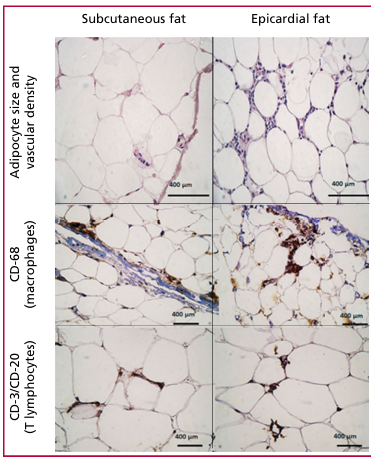
Epicardial adipose tissue (EAT) is a metabolically active tissue which has raised great interest in the last decade as a cardiovascular risk marker. It is related with the production of proinflammatory cytokines and free fatty acids, the promotion of a state of hyper coagulability and with numerous cardiometabolic risk factors. Between EAT and coronary arteries, there is not only an intimate anatomical association, but also bidirectional physiological aspects of paracrine regulation. In addition, several studies have found a relationship between EAT and endothelial dysfunction, non-obstructive atheromatosis, oxidative stress, atrial fibrillation and diastolic dysfunction.
Parallel to these findings, there is a tight association between hepatic steatosis (the most prevalent chronic hepatic disease), coronary atheromatosis and cardiovascular risk. One of the interesting and differential characteristics of hepatic steatosis with respect coronary artery disease is its dynamic, and to a certain point reversible, character.
Despite their association with atheromatosis and cardiovascular risk, and simple assessment from non-invasive imaging methods, epicardial fat and non-alcoholic fatty liver are seldom considered as risk markers in clinical practice.
Downloads
Published
Issue
Section
License
Copyright (c) 2020 Argentine Journal of Cardiology

This work is licensed under a Creative Commons Attribution-NonCommercial-ShareAlike 4.0 International License.





