
Transthyretin Cardiac Amyloidosis. Development of a Prediction Model and Scoring Scale for Diagnosis: deteCCTAR score
pp. 410-418
DOI:
https://doi.org/10.7775/rac.es.v92.i6.20838Keywords:
Amyloidosis, Prealbumin, Restrictive, Cardiomyopathy, Diastolic Heart Failure, Systolic Heart FailureAbstract
Background: To verify the diagnosis of transthyretin cardiac amyloidosis (ATTR-CA) in its early stages, certain warning signs or "red flags" have been lately identified to guide suspicion. However, to date, there is little evidence regarding the diagnostic sensitivity and specificity of each red flag or whether there is any combination of variables that can reliably predict the presence of ATTR-CA.
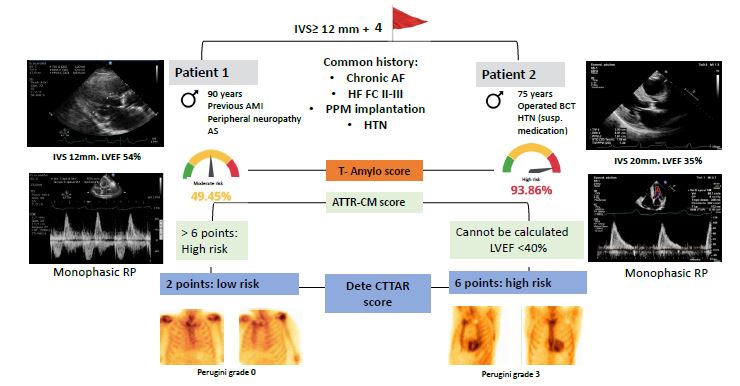
Objective: The aim of this study was to develop a prediction model based on clinical, electrocardiographic and/or echocardiographic variables to establish a scoring scale to guide the diagnosis of ATTR-CA.
Methods: The medical records of 342 patients with cardiac scintigraphy (CS) for suspected ATTR-CA were analyzed: 171 patients with a positive diagnosis were compared with the same number of patients with a negative diagnosis. Clinical, electrocardiographic and echocardiographic data were analyzed and included in univariate and multivariate logistic regression models. A 0-8 scoring scale was built and a receiver operating characteristic (ROC) curve was generated. The area under the curve (AUC) with its 95% CI was then calculated.
Results: The following variables were identified as predictors of ATTR-CA in univariate and multivariate logistic regression models: interventricular septum (IVS) ≥16 mm (OR 3.64, 95% CI 1.87-7.1), male gender (OR 7.91, 95% CI 3.7-17.1), grade II or III diastolic dysfunction with pseudonormal or restrictive relaxation pattern (OR 12.7, 95% CI 6.1-26.3), and history of bilateral carpal tunnel syndrome (CTS) (OR 24.4, 95% CI 6.1-97.9). Based on the OR obtained, a scoring scale was created showing an AUC of 0.88 (95% CI 0.84-0.91, p<0.001), and a value ≥3,
with high sensitivity and specificity, was identified to predict ATTR-CA (AUC 0.82 95% CI 0.77-0.87).
Conclusions: The prediction model allowed the development of a scoring scale that demonstrated high sensitivity and specificity to strongly guide the diagnosis of ATTR-CA.
How to cite this article:
Gobbo MY, Meretta AH, Carvelli MV, Elissamburu PF, Spaccavento A, Costabel JP, et al. Transthyretin Cardiac Amyloidosis. Development of a Prediction Model and Scoring Scale for Diagnosis: deteCCTAR score. Rev Argent Cardiol 2024;92:410-418.
Downloads
Published
Issue
Section
License
Copyright (c) 2024 Argentine Journal of Cardiology

This work is licensed under a Creative Commons Attribution-NonCommercial-ShareAlike 4.0 International License.





