
Usefulness of Doppler Echocardiography in the Diagnosis of Rejection in Cardiac Transplantation
pp 579- 584
DOI:
https://doi.org/10.7775/rac.v64i6.3790Keywords:
Echocardiography, Rejection , Cardiac transplantAbstract
Background
In order to reduce the number of endomyocardial biopsies in patients after cardiac transplant, the Doppler echocardiography is proposed as a valid option for non invasive evaluation.
Material and method
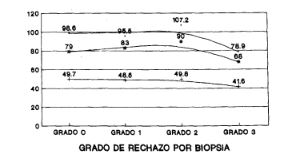
290 consecutive echocardiographic studies were performed simultaneously with endomyocardial biopsy on 40 patients who had received orthotopic cardiac transplantation within a thirty months period. Both procedures were analysed separately. Twenty four variables involved were analysed by means of mode M and two bidimensional echocardiography, Doppler and colour-Doppler echocardiography.All these variables were compared with the biopsy results. An ANOVA univariate analysis and chi square test was done.ResultsThe isovolumetric relaxation time, mitral pressure half time, and pulmonar peak velocity reached statistical significance values, p < 0.04, p< 0.05 and p< 0.05 respectively. Also did the presence of pericardical effusion, p < 0.06, and mean velocity circumferential fiber shortening with a p < 0.01. The biopsy founded 96 studies with 0 grade rejection, 141 with grade 1, 40 with grade 2 and13 with grade 3.
Conclusions
Mitral pressure halftime, isovolumetric relaxation time and pulmonar peak velocity demonstrated efficacy as early rejection indices in cardiac allograft transplant. Even showing statistical significance, the mean velocity circumferential fiber shortening is a late systolic phenomena. The low incidence of high grade rejection biopsy strenghtens the need of alternative non invasive diagnostic procedures.
Downloads
Published
Issue
Section
License
Copyright (c) 2026 Argentine Journal of Cardiology

This work is licensed under a Creative Commons Attribution-NonCommercial-ShareAlike 4.0 International License.





