
Slow intraventricular conduction due to depressed rapid responses in a case of trifascicular atrioventricular block
pp 171-174
DOI:
https://doi.org/10.7775/rac.v61i2.3296Abstract
The role of the time-dependent behavior of the slow-calcium channel in the mechanism of intraventricular block has been proposed on the basis of several in vitro studies. This hypothesis has not been substantiated by any clinical observation. Nevertheless, slow responses could be operative whenever intraventricular conduction is very slow even after long diastolic intervals, as normally occurs in the atrioventricular node. A 70 year old woman underwent an electrophysiologic study due to several syncopal attacks. The resting ECG showed 1st degree atrioventricular block together with right bundle branch block and left anterior hemiblock.
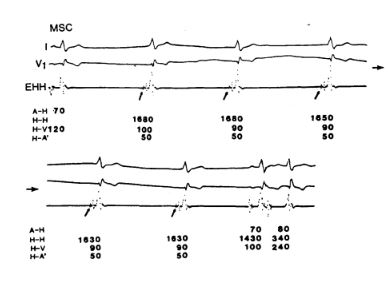
His bundle electrogram revealed a relatively short AH interval and a markedly prolonged HV interval(130 msec) denoting a very slow conduction over the posterior division of the left bundle branch. In addition, the relative refractory period of the posterior division was found to be unusually long whereas the effective refractory period was relatively short. These electro-physiologic features, commonly observed in the normal atrioventricular node, suggested that the posterior division of the left bundle branch had an injured are a with slow responses. However, the HV interval remained unmodified after IV verapamil administration while a marked lenghtening to 270 msec followed by complete infra hisian atrioventricular block, occured after N ajmaline injection. Findings in this patient as well as experimental and clinical observations in the same direction indicate that the slow calcium channel plays not a relevant role in the mechanism of intraventricular block. A depressed sodium channel seems to operate in most if not all cases of intraventricular block.
Downloads
Published
Issue
Section
License
Copyright (c) 2026 Argentine Journal of Cardiology

This work is licensed under a Creative Commons Attribution-NonCommercial-ShareAlike 4.0 International License.





