Optimization of Door-to-Balloon Time Implementing a Process Improvement Program. Results after 5 Years
pp. 135-139
DOI:
https://doi.org/10.7775/rac.es.v91.i2.20614Keywords:
Myocardial Infarction, Angioplasty, Time-to-TreatmentAbstract
Background: If available, primary transluminal coronary angioplasty (PTCA), performed timely and in experienced sites, is
the best reperfusion strategy for ST elevation myocardial infarction (STEMI). The door-to-balloon (DTB) time expresses
operational efficiency of the site in charge of the PTCA, with an impact on patient’s progress. The aim of this study was to
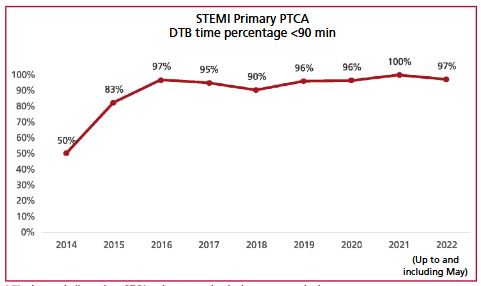
analyze the long-term results of a continuous improvement program for the DTB time process.
Methods: Patients diagnosed with STEMI who had undergone PTCA from January 2015 to May 2022 were prospectively and
consecutively enrolled. The population was divided in two periods: an immediate implementation period and a long-term
follow-up period.
Results: 671 patients were prospectively and consecutively enrolled. During the implementation period (P1) 91 patients were
enrolled, and 580 during the program follow-up (P2). The median (interquartile range, IQR) DTB time was 46 min (29-59) for
P1 vs 42 min(25-52) for P2, p=0.055). The second period showed a reduction in pre-activations (P1 54,1% vs P2 30% p=0.02)
and on-hour procedures (42% for P1 versus 30% for P2, p=0.029).
Conclusion: The registry showed long-term maintenance of good results, despite reduced reactivations and on-hour procedures.
How to cite this article:
Furmento J, Candiello J, Mascolo P, Lamelas P, Chapman I, Sigal A et al. Optimization of Door-to-Balloon Time Implementing a Process Improvement Program. Results after 5 Years. Rev Argent Cardiol 2023;91:135-9
https://doi.org/10.7775/rac.v91.i2.20614
Downloads
Published
Issue
Section
License
Copyright (c) 2023 Argentine Journal of Cardiology

This work is licensed under a Creative Commons Attribution-NonCommercial-ShareAlike 4.0 International License.