Impact of Allostatic Load on Cognitive Level, Memory and Left Ventricular Mass
pp 40-46
DOI:
https://doi.org/10.7775/rac.es.v87.i1.13508Keywords:
Stress, Physiological, Allostasis, Cognitive Dysfunction, Memory, Hypertrophy, Left VentricularAbstract
Background: Allostatic load (AL) has been proposed as a general framework for understanding the cumulative effects of life stress on individuals. Despite growing interest in AL, no research has been conducted in Argentina related to its impact on the heart and brain.
Objective: The aim of this study was to evaluate the association of AL, functionally defined by a range of measurements from the sympathetic and parasympathetic systems, hypothalamic-pituitary-adrenal axis, and inflammatory, cardiovascular and metabolic systems, with the cognitive level (CL), memory and left ventricular mass in middle-aged adults.
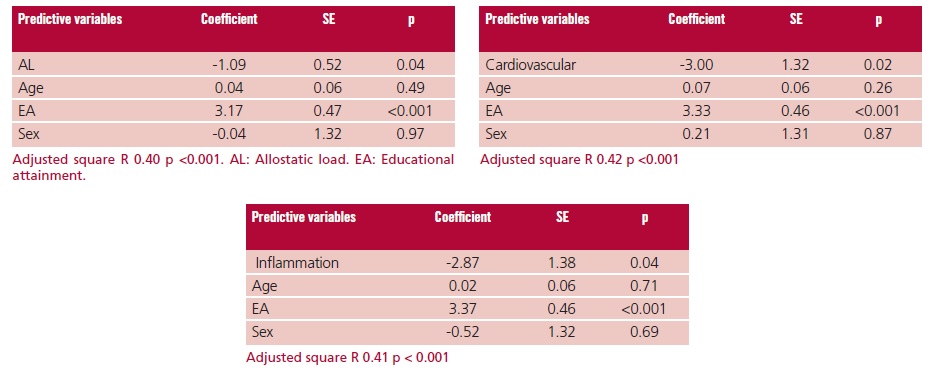
Results: A total of 86 patients were evaluated with mean age of 53.5 years (95% CI: 51.3 - 55.7). Allostatic load had a significant inverse association with the CL (coefficient -1.1; standard error: 0.5; p=0.04) that was independent of age, sex and educational attainment (adjusted square R: 0.40; p <0.001). Of the seven systems evaluated, only the cardiovascular and inflammatory systems had significant inverse associations with AL. An inverse relationship was also observed between AL and memory. In the heart, a positive correlation was found between AL and left ventricular (LV) mass (coefficient: 10.86; p <0.001; adjusted square R: 0.23; p <0.001).
Conclusions: Allostatic load is an objective tool to measure chronic stress. The results obtained indicate that high AL damages the brain (early cognitive and memory deficits) and the heart (increased LV mass).
Downloads
Published
Issue
Section
License
Copyright (c) 2025 Argentine Journal of Cardiology

This work is licensed under a Creative Commons Attribution-NonCommercial-ShareAlike 4.0 International License.