
Assessment of Educational Environment in Cardiology Residencies
pp. 373-378
DOI:
https://doi.org/10.7775/rac.es.v82.i5.3875Keywords:
Education, Medical, Educational Measurement, Internship and ResidencyAbstract
Background: The “educational environment,” which is the combined result of the physical environment, interpersonal relations, stressing factors, and the reward and penalty system, among others, influences student motivation, readiness to study, and academic achievement. Educational environment assessment focuses on student perception of the context beyond what might be “objectively” appreciated by an external observer.
Objective: The aim of this study is to present results obtained from the application of a local version of the PHEEM questionnaire to cardiology residents to explore whether their perception differs according to hospital public or private condition.
Methods: We applied the PHEEM (Postgraduate Hospital Educational Environment Measure) questionnaire, developed by S. Roff, S. McAleer, and A. Skinner, which is a specific tool to assess the educational environment in the hospital setting.
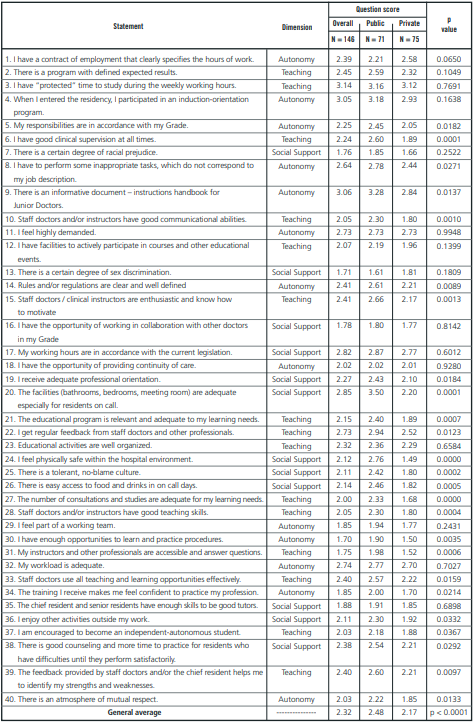
Results: One hundred and forty-eight residents from 31 Buenos Aires City and Greater Buenos Aires hospitals, who attended the 2012 Biennial Cardiology Course, completed the questionnaire: 71 residents from public hospitals, 75 from private hospitals, and 2 who did not identify hospital condition. Private hospital residencies showed significantly better learning conditions. Differences were found in supervision availability, sanitation facilities and resting/meeting rooms for doctors on call, the sense of physical security inside the hospital, and the adequate number of patients and studies for learning. There were no differences regarding the high level of exigency, poor feedback, and lack of “protected” time to study during working week hours.
Conclusions: It would be necessary to evaluate other specialty residencies and programs implemented in other jurisdictions, to analyze whether this is a general conclusion or it only applies to cardiology residencies in the metropolitan area.
Downloads
Published
Issue
Section
License
Copyright (c) 2025 Argentine Journal of Cardiology

This work is licensed under a Creative Commons Attribution-NonCommercial-ShareAlike 4.0 International License.





