
Evaluation of Mortality Risk with the IMPACT Scale in Patients with Cardiac Transplantation from a Latin American Population
pp. 465-470
DOI:
https://doi.org/10.7775/rac.es.v84.i5.7069Keywords:
Heart Transplantation - Mortality - Heart FailureAbstract
Background: Given the importance of optimizing organ allocation due to shortage of donors and high costs, it is essential to assess and improve survival rate in patients undergoing heart transplantation. There is currently no specific, integrated and widely accepted tool to assess mortality risk in these patients.
Objective: To assess the predictive capacity of the IMPACT scale for inhospital and one-year mortality in patients undergoing heart transplantation at the Colombian Heart Foundation.
Methods: This was a prospective cohort study of 72 patients. Incidences, survival curves, discriminative capacity of the final model, and factors associated with mortality were determined.
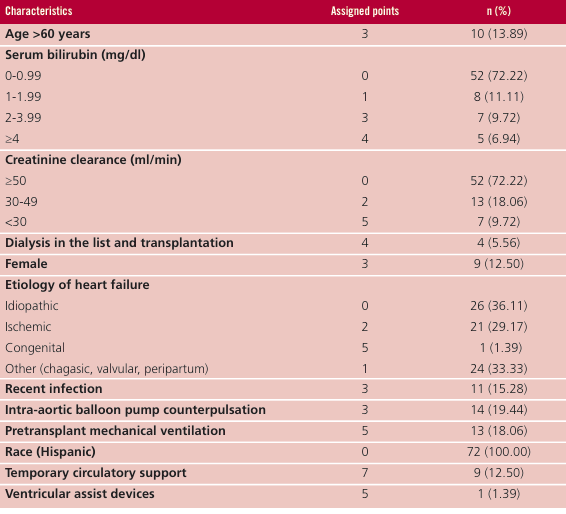
Results: The incidence of in-hospital and one-year mortality was 11.11% (95% CI 4.92-20.72) and 23.61% (95% CI 14.37-35.09), respectively. Patients >60 years of age (HR 2.68; 95% CI 1.54-4.66; p=0.000), with creatinine clearance <30 ml/min (HR 5.07; 95% CI 1.11-23.15; p=0.036), and dialysis (HR 1.66; 95% CI 1.15-2.40; p=0.006), had higher risk of in-hospital mortality. The characteristics associated with one-year mortality were age >60 years (HR 1.57; 95% CI 1.11-2.23; p=0.011), dialysis (HR 1.62; 95% CI 1.18-2.23; p=0.003), intra-aortic balloon pump counterpulsation (HR 1.42; 95% CI 1.02-1.98; p=0.040) and ventricular assist device (HR 1.57; 95% CI 1.03-2.3; p=0.034). The area under the ROC curve for in-hospital and one-year mortality after transplantation was 74.22% (95% CI 50.67-97.76) and 59.09% (95% CI 42.20-75.97), respectively.
Conclusions: IMPACT had better performance in predicting in-hospital than one-year mortality at our institution. It should be cautiously interpreted until variables explaining their regional performance are included.
Downloads
Published
Issue
Section
License
Copyright (c) 2016 Argentine Journal of Cardiology

This work is licensed under a Creative Commons Attribution-NonCommercial-ShareAlike 4.0 International License.





