
Prognostic Value of Clinical Presentation in Acute Heart Failure Syndromes
pp 33-39
DOI:
https://doi.org/10.7775/rac.es.v87.i1.13871Keywords:
Heart Failure, Shock, Cardiogenic, Hospital MortalityAbstract
Background: Heart failure is a highly prevalent disease with elevated morbidity and mortality. It is a very heterogeneous condition and there is no consensus in its classification.
Objective: The aim of this study was to compare the incidence of in-hospital and annual mortality as well as rehospitalizations due to heart failure, during the first follow-up year, according to the clinical presentation.
Methods: A retrospective descriptive and survival analysis was carried out in a cohort of 758 consecutive patients from the health plan of our hospital who were admitted to the cardiology intensive care unit for acute heart failure, evaluating the association between clinical presentation and annual mortality.
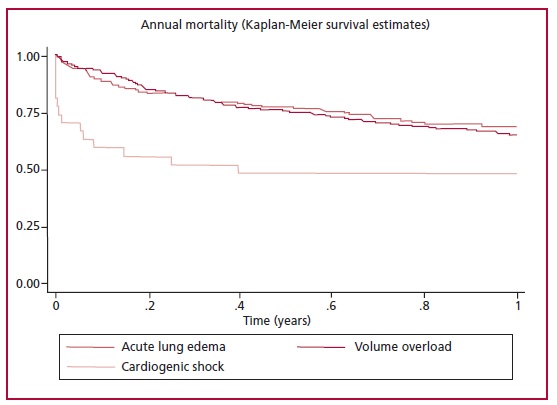
Results: Treatment and use of resources were different in the diverse presentations. Overall in-hospital mortality was 6.3%; 5.4% corresponded to acute pulmonary edema, 4.9% to volume overload and 40.7% to cardiogenic shock (p <0.001). The incidence of mortality per 100 patient-years was 40 (95% CI: 31-51), 45 (95% CI: 39-52) and 100 (95% CI: 60-100), respectively, with an incidence of 34.3% overall annual mortality. In the multivariate analysis, the annual mortality associated with cardiogenic shock had a HR of
3.39 (95% CI: 1.79-6.44) compared with that associated with acute pulmonary edema. There were no statistically significant differences in the rate of readmissions.
Conclusions: In patients with acute heart failure, clinical presentation was associated with mortality at one-year follow-up. Patients with cardiogenic shock on admission had a worse prognosis compared with the rest of the groups.
Downloads
Published
Issue
Section
License
Copyright (c) 2025 Argentine Journal of Cardiology

This work is licensed under a Creative Commons Attribution-NonCommercial-ShareAlike 4.0 International License.





