General Characteristics and Outcome of Patients with Acute Myocardial Infarction in Argentina According to Body Mass Index. (ARGEN-IAM-ST Registry)
pp. 113-117
DOI:
https://doi.org/10.7775/rac.v90i2.72Keywords:
Myocardial Infarction - Body Mass Index - Registries - ArgentinaAbstract
Background: Body mass index (BMI) in overweight and obesity ranges is an increasingly frequent cardiovascular risk factor. Its prognostic value is debatable in the setting of acute myocardial infarction (AMI).
Objectives: The aim of this study is to acknowledge the clinical characteristics, reperfusion strategies outcome of the cases included in the ARGEN-IAM ST according to BMI.
Methods: We conducted a prospective study of the cases included in the registry. Patients with incomplete anthropometric data were excluded. Three groups were defined: healthy BMI < 25 kg/m2 (G1), overweight: BMI between 25 and 29.9 kg/m2 (G2) and obesity: BMI ≥30 kg/m2 (G3).
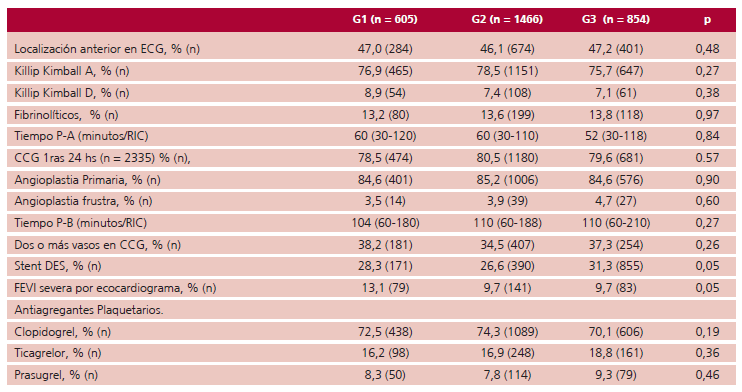
Results: 2925 cases were included. Patients in G3 were younger (G1: 63±12, G2: 61±11, G3: 60±11 years, p=0.0001), and had higher incidence of diabetes (G1: 11%, G2: 22%, G3: 28%; p=0.0001) and dyslipidemia (G1: 35%, G2: 40%, G3: 43%; p=0.01). There were no differences in door-to-balloon time (median 104 minutes in G1, 110 in G2 and 110 in G3, p=0.27),
two-vessel disease or greater (G1 38%, G2 34.5% and G3 37%; p=0.26) and in-hospital mortality (G1 9.7%, G2 7.5% and G3 8.4%; p=0.22). In multivariate analysis Killip class other than A (OR: 20.1; 95% CI 13.1-30.8; p<0.0001), age (OR: 1.7; 95% CI 1.2-2.5; p<0.0001) and two-vessel disease or greater (OR: 1.5; 95% CI 1.03-2.1; p<0.0001) were independent predictors of in-hospital mortality.
Conclusions: Overweight and obese patients were younger, with higher incidence of diabetes and dyslipidemia. There were no significant differences in the type of presentation, treatment and complications. In multivariate analysis, overweight and obesity were not predictors of mortality.
How to cite this article:
Frontera E, Pulmari C, Castillo Costa Y, D Imperio H, Charask A, Plogger C, et al. General Characteristics and Outcome of Patients with Acute Myocardial Infarction in Argentina According to Body Mass Index. (ARGEN-IAM-ST Registry). Rev Argent Cardiol 2022;90:113-7. http://dx.doi.org/10.7775/rac.v90.i2.20497