
Mitochondrial Complex I, H2O2 and NO as Prodromal Signals of Cardiac Dysfunction in Type 1 Diabetes
pp 90-95
DOI:
https://doi.org/10.7775/rac.es.v89.i2.19865Keywords:
Type 1 Diabetes Mellitus, Hyperglycemia, Mitochondrial Complex I, Heart mitochondria, Nitric Oxide, Hydrogen PeroxideAbstract
Background: Previous results from our laboratory suggest that heart mitochondrial dysfunction precedes myocardial failure associated with sustained hyperglycemia.
Purpose: The aim of this study was to analyze the early events that take place in heart mitochondria in a type 1 diabetes mellitus (DM) model.
Methods: Male Wistar rats were injected with streptozotocin (STZ; 60 mg/kg, ip.) to induce DM. They were euthanized 10 or 14 days later and the heart mitochondrial fraction was obtained.
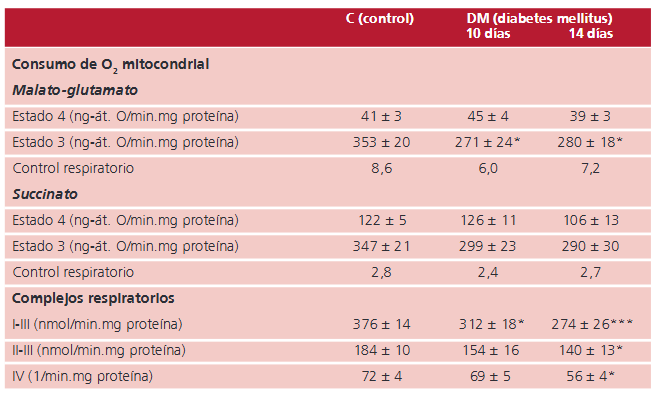
Results: State 3 O2 consumption in the presence of malate-glutamate (21%) or succinate (16%), and complex I-III (27%), II-III (24%) and IV (22%) activities were lower in diabetic animals 14 days after STZ injection. When animals were euthanized at day 10, only state 3 O2 consumption sustained by complex I substrates (23%) and its corresponding respiratory control (30%) were lower in rats injected with STZ, in agreement with reduced complex I-III activity (17%). These changes were accompanied by increased H2O2 (117%), NO (30%) and ONOO- (~225%) production rates, mtNOS expression (29%) and O2
- (~150%) and NO (~30%) steady-state concentrations, together with a decrease in Mn-SOD activity (15%) and mitochondrial [GSSG+GSH] (28%), without changes in PGC-1α expression.
Conclusion: Complex I dysfunction and increased H2O2, NO and ONOO- production rates can be considered subcellular prodromal signals of the mitochondrial damage that precedes myocardial dysfunction in diabetes.
Downloads
Published
Issue
Section
License
Copyright (c) 2025 Argentine Journal of Cardiology

This work is licensed under a Creative Commons Attribution-NonCommercial-ShareAlike 4.0 International License.





