
Weight, Height and Body Mass Index: Effectiveness of the "Clinical Insight" in the Correct Interpretation of Anthropometric Parameters
pp. 177-181
DOI:
https://doi.org/10.7775/rac.es.v93.i3.20894Keywords:
Obesity, Excess weight, Anthropometric indices, CorrelationAbstract
Background: Excess weight, defined as body mass index (BMI) ≥25 kg/m2, is associated with increased cardiovascular risk.
While BMI is easy to obtain, medical professionals often rely on their own clinical perception.
Objectives: The aim of the present study was to 1) evaluate the concordance between subjective estimates and actual measurements,
2) analyze if there is agreement between BMI categories as determined by objective measurements and as perceived
by physicians, and 3) assess if there is inter-observer variability in subjective perceptions of weight, height and BMI category.
Methods: We conducted a prospective and observational study. Cohen’s kappa index was used to analyze the degree of agreement
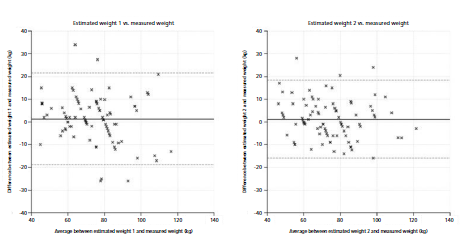
between observers. A value greater than 0.6 was considered “good correlation.” The Bland-Altman test was used to evaluate the differences between actual and estimated measurements. A difference greater than 5 kg in weight and greater than 5 cm in height between the actual and estimated measurements was considered clinically significant.
Results: A total of 87 patients were evaluated; 54% were men. More than 58% of the subjective perceptions of weight and 44% of height were significantly different from the objective measurements. The concordance between objective measurements of BMI and subjective impressions was not good.
Conclusion: In more than half of the cases, subjective perceptions of physicians when calculating weight, height, and BMI are inappropriate. There is significant variability in clinical perceptions. It is essential to measure objectively in order to properly categorize patients.
Downloads
Published
Issue
Section
License
Copyright (c) 2025 Argentine Journal of Cardiology

This work is licensed under a Creative Commons Attribution-NonCommercial-ShareAlike 4.0 International License.





