
Prognosis Value of Cardiac Power Determination in Patients with Chronic Heart Failure
DOI:
https://doi.org/10.7775/rac.v73i4.3940Keywords:
Natriuretic peptides, Myocardial ischemia, PrognosisAbstract
Work Objetive
To evaluate the predictive value of a new variable obtained through the cardiopulmonary exercise test, the maximum cardiac power (CPmx) during peak exercise.
Research Design and Methods
A group of heart failure were prospectively evaluated through the assessment of VO2mx, CPmx (oxygen pulse x mean arterial tension) and cardiac reserve (CR) (CPmx-CPbasal). The value were compared according to the presence of events (heart failure, hospitalization or death). The incremental value through ROC curve and the association of their cut-point with events (long-rank test and Cox regression) were evaluated. Combined end point: admission for worsening HF and/or death.
Results
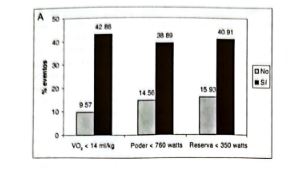
Sample of 157 patients, 83.4% men, aged 59 ± 10 years, functional class III/IV: 23.3%. Severe LV systolic dysfunction 56.7%, events 22.9%, average follow-up: 9 months. Patients with events showed lower values of VO2mx (11.8 vs 14.9 ml/kg/min, p<0.001), CPmx (831 vs 1079 watts, p=0.003) and CR (465 vs. 676 watts, p=0.002); ROC areas: VO2mx: 0.73; CPmx 0.68; CR 0.68, p=0.34 between areas). Risk of events: for VO2mx < 14 ml/kg/min HR 3.93 (95% CI 1.89-8.20) p<0.001; CPmx <780 HR 2.78 (CI 1.42-5.43), p=0.003 and CR<350 HR 2.75 (95% CI 1.42-5.35) p=0.003. The incidence of events was of 8.5% in patients with normal VO2 and CP, 30.3% with only one altered index: HR 3.1 (95% CI 1.16-8.25) p=0.024, and 45.2% with both indexes HR 5 (95% CI 1.81-13.75) p=0.002.
Conclusions
CPmx is another variable to determine in the cardiopulmonary exercise test which could give incremental predictive value, added to other classical parameters.
Downloads
Published
Issue
Section
License
Copyright (c) 2026 Argentine Journal of Cardiology

This work is licensed under a Creative Commons Attribution-NonCommercial-ShareAlike 4.0 International License.





