
Nocturnal Hypertension: Analysis According to its Severity
pp. 263-270
DOI:
https://doi.org/10.7775/rac.es.v92.i4.20798Keywords:
Hypertension, Nocturnal Blood Pressure, Coronary Heart Disease, Blood Pressure Monitoring, AmbulatoryAbstract
Background: In the diagnosis and follow-up of arterial hypertension (HTN) most practice guidelines recommend ambulatory blood pressure monitoring (ABPM). In this regard, there is increasing evidence supporting the superiority of nocturnal hypertension (NHTN) as a predictor of cardiovascular events. Little is known about the relationship with cardiovascular events
according to the severity of NHTN. Furthermore, it is unclear from what nighttime pressure value the risk begins to increase.
Objectives: The aim of this study was to determine whether the presence of NHTN and its severity levels are associated with adverse cardiovascular outcomes during follow-up.
Methods: An observational study was performed analyzing data collected from 24-hour ABPM studies obtained in a high complexity medical center in Buenos Aires. We examined patients’ clinical characteristics, laboratory findings, imaging studies and their results during the follow-up period. Our study included ≥18 year-old persons who had been diagnosed with hypertension. We defined NHTN as those cases with blood pressure values ≥120/70 mmHg during the nighttime period.
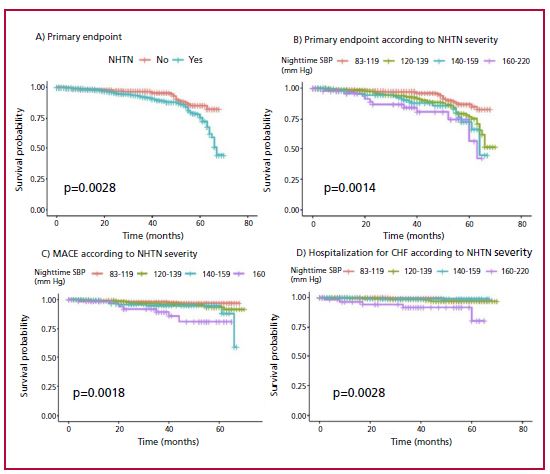
Results: The final analysis included 981 patients. Among these, 53% were men, mean age was 59.4 years and NHTN was present in 63.6% of cases (n=624). Nocturnal HTN was classified into four severity strata for comparison, according to the nighttime systolic blood pressure value: 83-119 mmHg, 120-139 mmHg, 140-159 mmHg and 160-220 mmHg. Major adverse cardiovascular events were recorded in 8 (2.2%), 17 (4.1 %), 8 (5.6%) and 7 (11.3%) subjects, respectively, and this difference between groups was statistically significant (p=0.007). Multivariate Cox regression analysis showed that the presence
of NHTN was an independent predictor of adverse cardiovascular events (HR 3.60; 95% CI 1.12-11.5; p=0.033), even when considering the presence of daytime hypertension.
Conclusion: In this contemporary cohort, NHTN and its severity were independently associated with the incidence of adverse cardiovascular events.
How to cite this article:
Perea J, Malano DJ, Fiori EA, Muslera C, Martín D, Gómez O, et al. Nocturnal Hypertension: Analysis According to its Severity. Rev Argent Cardiol 2024;92:263-270. http://dx.doi.org/10.7775/rac.v92.i4.20798
Downloads
Published
Issue
Section
License
Copyright (c) 2024 Argentine Journal of Cardiology

This work is licensed under a Creative Commons Attribution-NonCommercial-ShareAlike 4.0 International License.





