The excitable gap in atrioventricular nodal reentrant tachycardia
pp 563-577
DOI:
https://doi.org/10.7775/rac.v64i6.3789Keywords:
Excitable gap, Nodal reentryAbstract
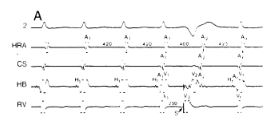
Atrioventricular nodal reentrant tachycardia is a common cause of narrow complex tachycardia and is the most frequently encountered in clinical practice. Recent advances in catheter ablation techniques have highlighted the importance of a more complete understanding of the anatomic and electrophysiologic substrate of this tachyarrhythmia. The most common circuit is presumed to result from a longitudinal dissociation of AV nodal conduction into anterograde"slow" and retrograde "fast" components. When the tachycardia is due to functional or anatomically determined reentry, an excitable gap is usually present between the tail of refractoriness of the. last tachycardia impulse and the newly arriving tachycardia wave front. An appropriately timed extra stimulus will therefore be able to penetrate the reentrant circuit and thereby actyivate the excitable tissue in the same pattern as the reentrant wave front. This phenomenon is called resetting. When the tachycardia circuit is penetrated by a train of extrastimuli resulting in repetitive resetting, the phenomenon is referred as entrainment.
Downloads
Published
Issue
Section
License
Copyright (c) 2026 Argentine Journal of Cardiology

This work is licensed under a Creative Commons Attribution-NonCommercial-ShareAlike 4.0 International License.