
Incidence of Atrial Thrombus and Spontaneous Echocontrast in Atrial Flutter
pp 333-338
DOI:
https://doi.org/10.7775/rac.v67i3.3644Keywords:
Aleteo auricular, Trombo, Ecocontraste espontáneoAbstract
Background
Cardiovascular embolism is very common in patients with stroke. Almost half of the cases occur when atrial fibrillation is present. Although there is a lot of information on the presence of atrial thrombus in patients with atrial fibrillation, little is known about what happens in those with atrial flutter.
Objectives
This study was performed to determine the incidence of atrial thrombus and spontaneous echocontrast in patients with atrial flutter, using transesophageal echocardiography.
Methods
Twenty consecutive patients with atrial flutter lasting more than 72 hours, without anticoagulation therapy, were included in the study. These patients were referred to the coronary care unit for electrical cardioversion. Both transthoracic echocardiography and transesophageal echocardiography were performed in all patients in order to identify an atrial thrombus, the presence and intensity of spontaneous echo contrast and to assess the left ventricular systolic function. These studies were performed in accordance to the American Society of Echocardiography's criteria.
Results
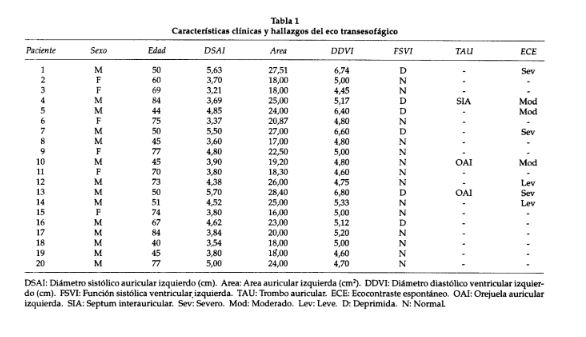
Out of the 20 patients evaluated, atrial thrombus and spontaneous echo contrast in the left atrium were detected in 3 patients (15%) and in 8 patients (40%), respectively. Atrial thrombus were detected in the left atrial appendage in 2 patients (66.6%) and in the atrial septum in 1 patient (33.3%). The spontaneous echocontrast was moderate to severe in 6 patients (75%) and mild in the other 2 patients (25%). Out of the 3 patients with atrial thrombus, 2 patients (66.6%) had atrial enlargement and left ventricular systolic dysfunction, while both parameters were normal in the third of the patients (33.3%). Five of the 8 patients (62.5%) with spontaneous echo contrast had left ventricular systolic dysfunctionand 7 patients (87.5%) had atrial enlargement. Statistical significance (p < 0.005) was found when left ventricular systolic dysfunction and the presence of spontaneous echo contrast were correlated.
Conclusions
In our series, the incidence of atrial thrombus and spontaneous echo contrast were 15% and 40%, respectively. These findings would support the use of a transesophageal echocardiogram or anticoagulant therapy before cardio version. Future prospective controlled studies, with a larger number of patients, are needed to confirm these results.
Downloads
Published
Issue
Section
License
Copyright (c) 2026 Argentine Journal of Cardiology

This work is licensed under a Creative Commons Attribution-NonCommercial-ShareAlike 4.0 International License.





