
Insulin Resistance: Hyperinsulinemia in Essential Hypertension
pp 597-603
DOI:
https://doi.org/10.7775/rac.v62i6.3546Keywords:
Essential hypertension, Hyperinsulinemia, Insulin resistance, Salt-sensitive hypertensionAbstract
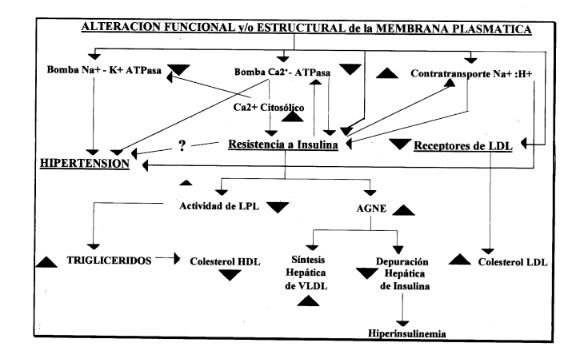
Insulin resistance is associated with risk factors of atherosclerosis such as hypertension, non-insulin dependent diabetes mellitus, dyslipidemia and obesity. These risk factors are frequently present in the same individual. The causative relationship between insulin resistance/hyperinsulinemia and essential hypertension is controversial. Insulin resistance activates Na+/H+ antiport. Insulin regulates both Na+/K+-ATPase and Cat+-ATPase pumps. The increase in cytosolic Ca2+, protein kinase C activator and Na+/H+ antiport participate in insulin resistance. In the human LDL receptor, there is a tetrameric sequence shared by other cell surface proteins, including tyrosine kinase-linked receptors of the epidermal growth factor and insulin receptor family. Insulin resistance is associate with an atherogenic lipidemic profile. This paper proposed that these complex interrelationships among several alteration whose incidence is significantly higher in hypertension may be an expression of a functional and/or structural disorder of the cell membrane. The latter might have a greater incidence than estimated heretofore and would not bean exclusive feature of salt-sensitive hypertension.
Downloads
Published
Issue
Section
License
Copyright (c) 2026 Argentine Journal of Cardiology

This work is licensed under a Creative Commons Attribution-NonCommercial-ShareAlike 4.0 International License.





