
Left Ventricular Diastolic Function in hypertension. Relation to mass index with Doppler echocardiography
pp 426-430
DOI:
https://doi.org/10.7775/rac.v59i6.3431Abstract
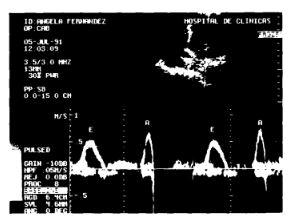
The aim of this study was the assessing of LVDF related to left ventricular mass index (L VMI) in untreated hypertensive patients (HT) and normotensive controls (N) by means of Echo-Doppler (ED). ED was used to evaluate the pattern of left ventricular filling and L VMI in 31 HT with essential hypertension WHO I-ll (19 women and 12 mean) and 19 N of similar age. The HT were classified into two groups according to their LVMI: A, with LVH (n = 14) and B, without LVH (n = 17). N were considered as group C. We took into consideration the peak early filling velocity (E), the atrial time velocity (A), the peak early to late (atrial) filling velocity ratio (EI A) and also the atrial time velocity integral, whole fining integral and the atrial to whole integral ratio (those data were not included because their lack of statistic significance). We also considered pressure half-time and L VMI. Statistical analysis used the Fisher-Snedecor test for three samples with the Turkey-Snedecor complementary test. Conclusions: ED may detect left ventricular diastolic dis- function; the abnormalities were a reduction of E and an increase in A. The LVH does not show any influence in those observations with regard to patients without hypertrophy. Diastolic function abnormalities of left ventricle in HT may be not dependent on L VH. Nevertheless, the onset of LVH aggravates left ventricular diastolic disfunction.
Downloads
Published
Issue
Section
License
Copyright (c) 2026 Argentine Journal of Cardiology

This work is licensed under a Creative Commons Attribution-NonCommercial-ShareAlike 4.0 International License.





