
Autoantibodies Against Beta Adrenergic Receptors in Patients with Primary Electrical Cardiac Abnormalities
pp 119-127
DOI:
https://doi.org/10.7775/rac.v64i2.3373Keywords:
Beta adrenergic receptors, Atrial arrhythmias, Ventricular arrhythmias, Conduction blocks, Idiopathic dilated cardiomyopathy, Chagas' diseaseAbstract
Background
Using synthetic peptides corresponding to the predicted sequences for the second extracellular loop of the human beta 1 and beta 2-adrenoceptors as antigenic targets, autoantibodies directed against the beta-adrenoceptors were recently shown to occur in patients with idiopathic dilated cardiomyopathy and Chagas' heart disease. Based on these observations we intended to determine the prevalence of autoantibodies directed against the beta-adrenoceptors in patients with primary electrical cardiac abnormalities, including atrial arrhythmias, ventricular arrhythmias and conduction disturbances, in the absence of any other cardiac ab-normality.
Material and method
One hundred and fifty three patients(57 with primary electrical abnormalities,29 with idiopathic dilated cardiomyopathy and 67 with chronic Chagas' disease) and 101 healthy and cardiopathic control subjects were studied.Antibodies against the beta 1 and beta 2 peptides were detected with an enzyme immunoassay performed in blinded manner. In nine selected (seropositive) cases, the immunoglobulin G (IgG) fraction was tested for functional effects on the rate beating of cultured neonatal rat cardiomyocytes.
Results
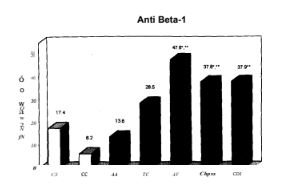
Antibodies recognizing the beta 1 and beta 2 pep-tides were found in 11 (52.3%) of 21 patients with ventricular arrhythmias (p < 0.01), 5 (35.7%) of 14 patients with conduction disturbances (p < 0.05), 3 (13.6%) of 22 patients with atrial arrhythmias (p < 0.05), 11(37.9%) of 29 patients with dilated cardiomyopathy(p < 0.05) and 31 (46.3%) of 67 patients with chronic Chagas' disease (p < 0.05) compared with 15 (14.8%)of 101 control subjects. A rapid increase in the beat-ing rate of the cultured myocytes was induced byIgG from a selected group of patients, suggesting an agonist-like interaction with a functional epitope. This response was mediated by stimulation of both the beta 1 and beta 2-adrenoceptors in the patients with primary ventricular arrhythmiasbut only the beta 1-adrenoceptors in the patients with idiopathic dilated cardio-myopathy.
Conclusions
Primary ventricular arrhythmias and conduction disturbances, like idiopathic dilated cardiomyopathy, and chronic Chagas' disease show a high prevalence of antibodies interacting with functional epitopes of the beta-adrenoceptors, suggesting a common or similar abnormal immunorregulatory process.
Downloads
Published
Issue
Section
License
Copyright (c) 2026 Argentine Journal of Cardiology

This work is licensed under a Creative Commons Attribution-NonCommercial-ShareAlike 4.0 International License.





