
Recurrencia de los episodios sincopales en pacientes con síncope neurocardiogénico
pp 155-160
DOI:
https://doi.org/10.7775/rac.v65i2.3472Palabras clave:
Síncope, Síncope neurocardiogénico, Pronóstico, Seguimiento, RecurrenciaResumen
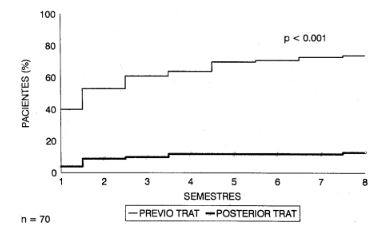
De una población de 397 pacientes con diagnóstico de síncope asistidos entre 1991 y 1996 en forma consecutiva, hemos seleccionado 70 con diagnóstico de síncope neurocardiogénico . En este grupo, el diagnóstico se efectuó a través de un protocolo que incluía interrogatorio, examen físico y Tilt test . Se reconstruyó la cronología de los episodios sincopales hasta el momento de la primera consulta, a través del interrogatorio al paciente y familiares cercanos, y posteriormente con un seguimiento de 1 a 5 años . No se indicó ningún tipo de tratamiento farmacológico luego de la primera consulta . Una vez establecido el diagnóstico, sólo se dieron instrucciones específicas para evitar las situaciones que actuaban como desencadenantes. Para el análisis de la recurrencia de los episodios se utilizó el método actuarial de Kaplan-Meier . La edad media fue de 30,7 ± 16,3; fueron 35 hombres y 35 mujeres . A través del método actuarial de Kaplan-Meier se observó que, luego del primer episodio, en los cuatro primeros años había repetido episodios sincopales el 74% de la población, mientras que luego de la consulta en igual período recurrió sólo el 13% . Esta diferencia resultó significativa (p < 0,001) . La historia natural de los pacientes con síncope mediado neuralmente no ha sido completamente aclarada . Estos hallazgos sugieren que efectuar el diagnóstico e indicar actitudes preventivas representa una intervención capaz de modificar la evolución natural de la enfermedad.
Descargas
Publicado
Número
Sección
Licencia
Derechos de autor 2026 Revista Argentina de Cardiología

Esta obra está bajo una licencia internacional Creative Commons Atribución-NoComercial-CompartirIgual 4.0.





