
High-resolution electrocardiography: averaged signals. Values in healthy individuals
pp 85-90
DOI:
https://doi.org/10.7775/rac.v60i1.3258Abstract
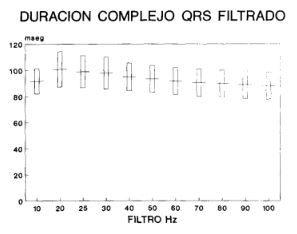
At least half the deaths of patients with cardiovascular disease occur suddenly and unexpectedly. Current noninvasive techniques for assessment of patients at risk for sudden death have poor predictive value. Signal averaging of the surface ECG is a new noninvasive computerized method of analyzing standard ECGs that identifies patients at risk for ventricular tachycardia with good specificity and predictive value. The study comprised 50 normal volunteers, 30 men, and their ages ranges from 14 to 59 years (X 33.7 ± 9.2). The signal was recorded with the Arrhythmia Research Technology 1200 EPX unit using Simson's methods. A total of 11 high-pass fIlter settings were used with the low pass cutoff frequency fixed at 250 Hz. Noise level (1.0 uV at 25 Hz and < 0,7 uV at 40 Hz. The paramters were defined as: a) the duration of the filtered QRS, b) LAS, the duration of low amplitude signals measured from the filtered QRS offset backward to when the signal reaches 40 uV and c) RMS, the root mean square voltage of the terminal 40 ms of the filtered QRS complex. The values commonly employed in the literature are with 25 and 40 Hz: a) QRS duration 108 and 104 ms, b) LAS 44 and 38 ms and c) RMS 31 and 23 uV respectively for 25 and 40 Hz. The values were significantly influenced by the high pass filter setting. This group is characterized by short QRS duration and LAS and high RMS.
Downloads
Published
Issue
Section
License
Copyright (c) 2026 Argentine Journal of Cardiology

This work is licensed under a Creative Commons Attribution-NonCommercial-ShareAlike 4.0 International License.





