Variables Associated with Successful Cardiopulmonary Resuscitation After In-Hospital Cardiac Arrest. Research Committee. Argentina Society of Cardiology. 1999
pp 45-52
DOI:
https://doi.org/10.7775/rac.v68i1.3094Keywords:
Cardiac arrest, In-hospital cardiopulmonary resuscitation, Ventricular arrhythmia, Ventricular fibrillationAbstract
Background
We lack of information about the characteristics, treatment and evolution of patients submitted to cardiopulmonary resuscitation (CPR), during their in-hospital stay in our country.
Materials and methods
One hundred adult patients of both sexes, mean age 67.8 ±12.0 years old, were included in the study.They had been admitted in a monitored area dueto an acute cardiac condition or worsening of a chronic one. During their in-hospital stay patients suffered a cardiac arrest and were treated with adult advanced cardiopulmonary support. Their main characteristics, heart disease, procedures employed and in-hospital evolution were analyzed.
Results
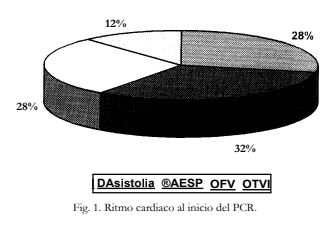
Initial reversion (IR) was achieved in 44 patients (44.0%). At hospital discharge, the survival rate was 17.0% (17 patients). With a logistic regression model employed to predict IR, the presence of ventricular tachycardia or ventricular fibrillation (OR 8.8 CI 95% 2.2-35.6; p < 0.001) and the duration of CPR (OR 0.9 CI 95% 0.86-0.94; p < 0.001) were identified as independent markers. Applying the above mentioned model to predict survival at hospital discharge, the same variables remained as independent markers of outcome (OR 3.3 CI 95% 1.1-13.0, p = 0.05; OR 0.91 CI 95% 0.87-0.96, p < 0.001, respectively). Age less than 69 years was not an independent marker of better hospital outcome.
Conclusions
The initial rhythm at arrest and the duration of resuscitation were identified as prognostic markers of in-hospital evolution. The rate of survival in monitored areas reported here is below those de-scribed in the international literature. These results suggest that the implementation of a training program in advanced cardiopulmonary support might result in an improvement of the results obtained in cardiopulmonary resuscitation.
Downloads
Published
Issue
Section
License
Copyright (c) 2026 Argentine Journal of Cardiology

This work is licensed under a Creative Commons Attribution-NonCommercial-ShareAlike 4.0 International License.