
Radiofrequency Ablation for Atrial Flutter
pp 393-401
DOI:
https://doi.org/10.7775/rac.v69i4.3081Keywords:
Radiofrequency ablation, Atrial flutter, Atrial fibrillation, Cardiac arrhythmia, HumansAbstract
Medical treatment of atrial flutter is often difficult because of low effectiveness of antiarrhythmic drugs and high recurrence rate. Radiofrequency catheter ablation of the cavotricuspid isthmus (CfI) has been postulated as an alternate option in the treatment of isthmus-dependent atrial flutter. We present the results, complications and recurrences of atrial flutter and fibrillation after CTI ablation in patients with typical atrial flutter. We performed 103 procedures in 100 consecutive patients with typical atrial flutter. The ablation end point was complete bi-directional CTI conduction block. Thirty-two patients (32%) had a previous history of atrial fibrillation. The primary success rate was 96%. During the follow up (14 :t 9 months) atrial flutter recurrence rate was 3%. Total atrial fibrillation recurrence rate was 21% (21 patients). Seven- teen of these 21 patients (81%) had a previous his- tory of atrial fibrillation. In addition, of the 32 patients with previous history of atrial fibrillation 17 (53%) presented recurrences of the arrhythmia. Major complication occurred in 3 patients and mi- nor complications in one. All of them resolved with- out permanent damage. The electrogram polarity inversion, recorded in the low lateral right atrium during CTI block, was a useful marker os isthmus block. In addition a catheter positioned in the tricuspid annulus was also a useful marker of acute success. Cavotricuspid isthmus bi-directional block is a highly effective treatment for typical atrial flutter. The procedure is safe and complication rate is low. Atrial flutter recurrences are rare, but patients with previous history of atrial fibrillation are prone to recur with this arrhythmia. Cavotricuspid isthmus ablation should be considered as a first line therapy for recurrent typical atrial flutter.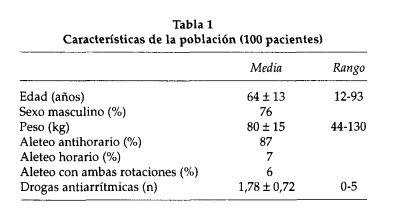
Downloads
Published
2026-03-02
Issue
Section
ORIGINAL ARTICLES
License
Copyright (c) 2026 Argentine Journal of Cardiology

This work is licensed under a Creative Commons Attribution-NonCommercial-ShareAlike 4.0 International License.





