ATD Depletion in Red Blood Cells of Rabbits Fed with an Atherogenic Diet
pp 194-200
DOI:
https://doi.org/10.7775/rac.v70i3.2981Keywords:
Adenosine triphosphate, Erythrocyte, Atherogenic diet, Hypercholesterolemia, Pyruvate kinase, Hemolytic anemia, AtherogenesisAbstract
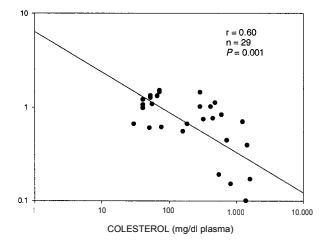
In an experimental study with rabbits fed with anatherogenic diet, the relation between hypercholesterolemia and the generation of a hemolytic anemia has been investigated. Although this process has been described in different species its ethiology is not completely understood. Two groups of rabbits (A yB)were fed with a diet supplemented with 1.0 and 0.5% of cholesterol, respectively. After 40 days of cholesterol feeding the group A showed a significant decrease (p < 0.001) of the membrane erythrocyte adenosinetri-phosphate (eATP) compared with the control group: 0.16 ± 0.13vs 1.09 ± 0.32 mmol/L (mean±SD). During periodic evaluations in the groupB,eATP decrease was detected at day 15, being significant at day 30 (p < 0.05).Erythrocyte adenosine monophosphate tended to increase at day 30 and plasma inorganic phosphorus did not showed variations. Plotting eATP against plasma cholesterol levels, a significant in-verse correlation was found (r = - 0.6, p = 0.001). Enzymatic studies showed that erythrocyte piruvate kinase increased significantly at day 30(p < 0.05) and glucose-6-phosphate dehydrogenase decreased without statistical significance at day 15.The lowest hematocrit and hemoglobin values were found at the highest cholesterol levels. The corpuscular volume increased, reaching a peak at day 15. It is suggested that hypercholesterolemia could be involved in erythrocyte dysfunctions that would generate eATP depletion and a hemolytic anemia, in addition to its well known role in atherogenesis
Downloads
Published
Issue
Section
License
Copyright (c) 2026 Argentine Journal of Cardiology

This work is licensed under a Creative Commons Attribution-NonCommercial-ShareAlike 4.0 International License.