
Right-Side Transcatheter Valve Replacement with “Valve-In-Valve” Technique in Congenital Heart Disease: Initial Experience in Argentina
pp 423-428
DOI:
https://doi.org/10.7775/rac.es.v91.i6.20713Keywords:
Heart defects, Congenital, Bioprosthesis, Valve dysfunction, Transcatheter replacement, Valve in valveAbstract
Background: Surgical replacement using bioprostheses is a frequently used strategy to treat right-side heart valves dysfunction in congenital heart disease.
Objective: The aim of this study was to present the initial experience in Argentina with right-side bioprosthetic valve ring fracture/remodeling and subsequent transcatheter valve-in-valve replacement in patients with congenital heart disease.
Methods: This was a descriptive and observational study including all patients treated with transcatheter replacement due to bioprosthetic valve dysfunction.
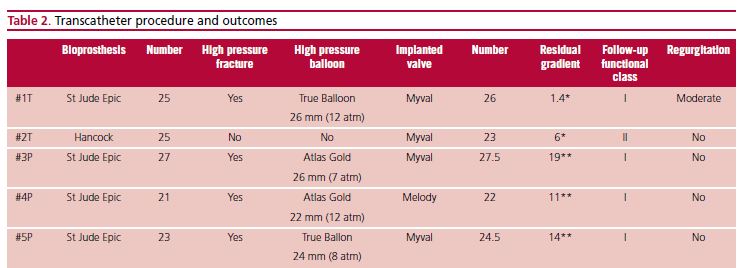
Results: From August 2021 to May 2023, 5 patients (3 female) with right-side bioprosthetic dysfunction underwent transcatheter intervention as an alternative to de novo surgical replacement. Mean age was 21.2±9.20 years and mean weight 56.2±22.2 kg. Five balloon expandable valves were implanted: 3 in pulmonary position and 2 in tricuspid position, in 4 cases with previous fracture of the valve ring. In all cases, valve function was restored without complications. During follow-up, moderate right valve incompetence was observed in one case.
Conclusion: Transcatheter “valve-in-valve” replacement in dysfunctional right-side heart bioprostheses is an attractive and safe strategy in selected cases, which restores competence and eliminates obstructions. This approach is a reasonable option as alternative to de novo surgical valve replacement.
How to cite this article:
Peirone A, Contreras A, Cabrera M, Banille E, Guevara A, Juaneda I, y cols. Right-Side Transcatheter Valve Replacement with “Valve-In-Valve” Technique in Congenital Heart Disease: Initial Experience in Argentina. Rev Argent Cardiol 2023;91:423-428 http://dx.doi.org/10.7775/rac.v91.i6.20713
Downloads
Published
Issue
Section
License
Copyright (c) 2023 Argentine Journal of Cardiology

This work is licensed under a Creative Commons Attribution-NonCommercial-ShareAlike 4.0 International License.





