Cardiorespiratory modifications during the dance
pp 358-363
DOI:
https://doi.org/10.7775/rac.v70i5.2658Keywords:
Tango and VO2, Tango and cardiovascular prevention, Tango and exercise testingAbstract
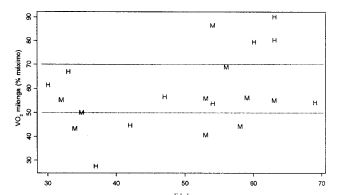
Several dances have proved to be a valid alternative against sedentary life style. No previous research was found after a literature review on the cardiorespiratory modifications produced when dancing tango. Purpose: The aims of this research were to study the oxygen uptake (VO2), heart rate (HR) and minute ventilation (VE) during the tango and milonga dancing and to compare these results with those obtained on the same people during maximal exercise testing. Methods: VO2, VE, HR of twenty healthy individuals were measured during a maximal exercise test and during the dance of 2 tangos ("La cumparsita" y "Quejas de bandoneón") and 1 milonga ("La puñalada"). Results: the VO2 during tango and milonga dancing were 12.3, 12.0 and 15.1 ml O2/kg/min (46%, 42% and 55% of maximal VO2). The HR values were 112, 108 and 118 beats/min during dance (68%, 69% and 77% of maximal HR). The VE values were. 18, 20 y 25 1/min (26%, 30% y 36% of maximal VE). VO2 values were 86%, 82% and 104% of the anaerobic threshold VO2 and HR values while dancing were 90%, 92% y 102% ofthe anaerobic threshold HR. The VO2, HR and VE values during milonga dance were higher than during tango dance. The correlations between age and % of the maximal VO2 were 0.46 (p = 0.04), 0.44 (p = 0.006) and 0.31 (p = 0.18) for each tango and milonga, respectively. Conclusions: tango and milonga dances are exercises of light or moderate intensity. VO2 values during these practices are at the anaerobic threshold level or below it. Tango dancing is an exercise of lower intensity than milonga dancing. The percent of the maximal VO2 reached was higher in old people.
Downloads
Published
Issue
Section
License
Copyright (c) 2026 Argentine Journal of Cardiology

This work is licensed under a Creative Commons Attribution-NonCommercial-ShareAlike 4.0 International License.