
Pharmacological Stress in Chagas Disease: A Doppler-Echo Study
pp 12-19
DOI:
https://doi.org/10.7775/rac.v75i1.2529Keywords:
Chagas Disease, Echocardiography, Doppler, Dobutamine, Echocardiography, stress, Chagas cardiomyopathyAbstract
In normal subjects, myocardial velocities assessed with Doppler tissue imaging (DTI) increase by a mean of 140% during dobutamine stress echocardiography.
Objectives
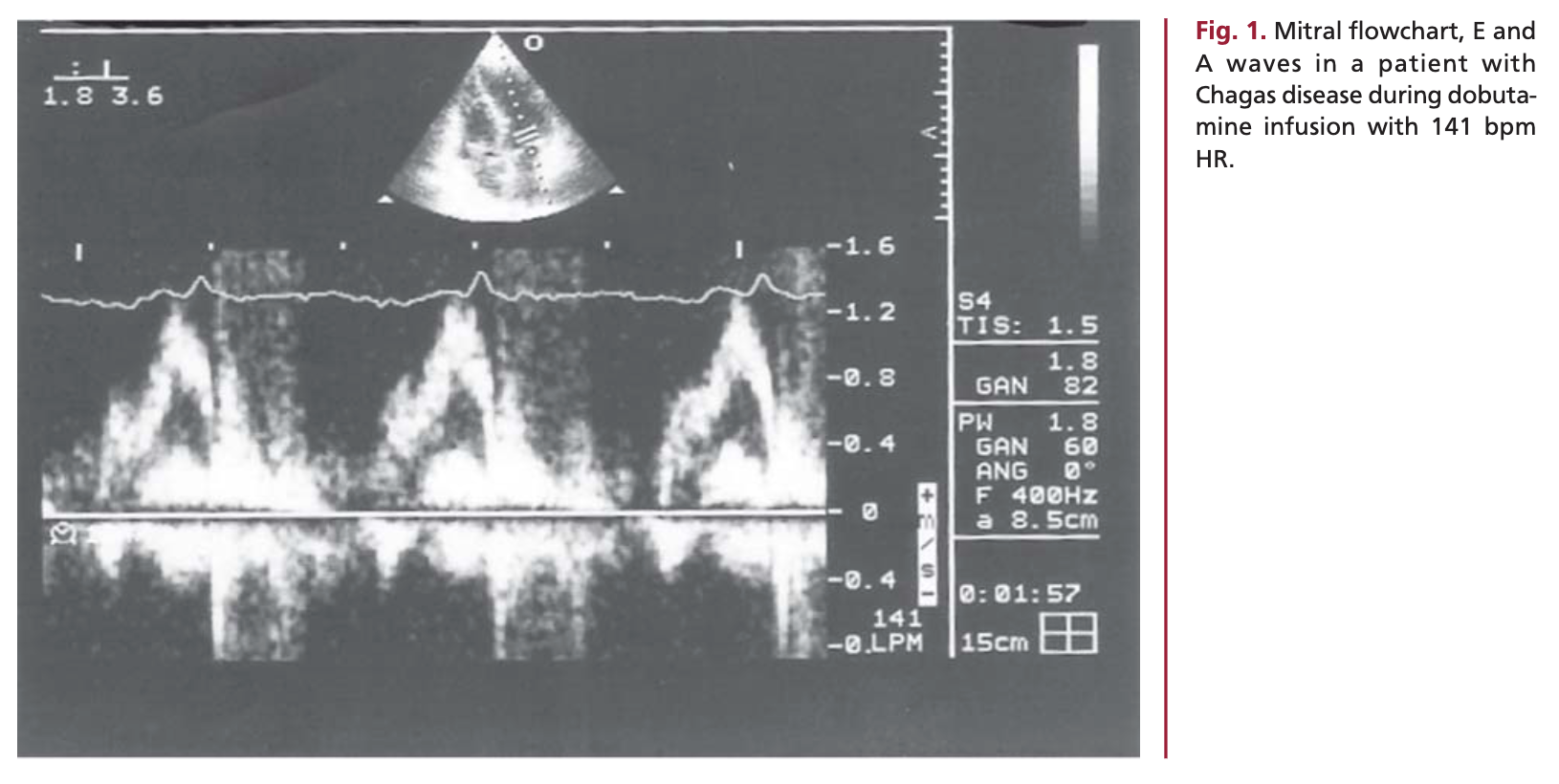
The purpose of this study was to investigate whether dobutamine stress echo associated with left ventricular (LV) DTI could demonstrate incipient cardiomyopathy in patients with Chagas disease without evidence of heart disease assessed by conventional tests. We evaluated 39 patients (14 men and 25 women) with a mean age of 44 years (range 29 to 67 years), who were serologically positive for Chagas disease without obvious heart disease (group A). Heart rate (HR), systolic blood pressure (SBP) and diastolic blood pressure (DBP) were measured. Chest X-rays and ECG’s were performed. The following parameters were measured with Doppler-echocardiography: left ventricular diastolic (LVDD) and systolic (LVSD) diameters, fractional shortening (FS), segmental wall motion and LV area fractional shortening (AFS), E and A velocities (m/ sec) and mitral flow E/A ratio. Myocardial velocities (Vm), diastolic Em velocity (myocardial velocity during early filling), Am (myocardial velocity during atrial contraction), Sm systolic velocity and the Em/ Am ratio were measured with DTI in the basal segment of the anterolateral wall and the mid segment of the lower septum. Dobutamine was administered up to a dose of 40 gammas/kg/ min and measurements were repeated with the maximu dose. These results were compared to those obtained in 15 normal subjects (group B).
Results
Post dobutamine, HR increased from 65 beats per minute (bpm) to 120 bpm in group A (p<0.001) and from 74 to 151 bpm in group B (p<0.001). Maximum HR attained was lower in group A than in group B; i.e., 120 vs. 151 bpm (p<0.01). Wall motion was normal in 38 patients (group A). Post dobutamine, the increase in Vm compared to baseline Vm were, in group A: Em 9% (NS), Am 6.6% (NS) and Sm 15% (NS) and in group B: Em 46% (p < 0.05), Am 72% (p < 0.01) and Sm 108% (p < 0.01). Post dobutamine, FS and AFS were significantly increased in both groups. Statistical Analysis The Wilcoxon test was used (Kiwistat 2001) and a p value <0.05 was considered significant.
Conclusions
Patients with Chagas disease exhibited chronotropic impairment and a lesser increase in Vm post stress than normal subjects. The scarce increase in Vm with dobutamine could suggest the presence of an incipient cardiomyopathy.
Downloads
Published
Issue
Section
License
Copyright (c) 2026 Argentine Journal of Cardiology

This work is licensed under a Creative Commons Attribution-NonCommercial-ShareAlike 4.0 International License.





