Impact of Optimizing Lipid-Lowering Therapy on Residual Cardiovascular Risk
pp. 309-316
DOI:
https://doi.org/10.7775/rac.v91i5.243Abstract
Background: The SMART-REACH model predicts the risk or recurrent cardiovascular events.
Objectives: The objectives of this study were: a) to evaluate the residual cardiovascular risk in a secondary prevention population with low-density lipoprotein cholesterol (LDL-C) levels above the recommended goal, using a simulation model; and b) to determine the impact of optimizing lipid-lowering therapies in terms of residual cardiovascular risk reduction.
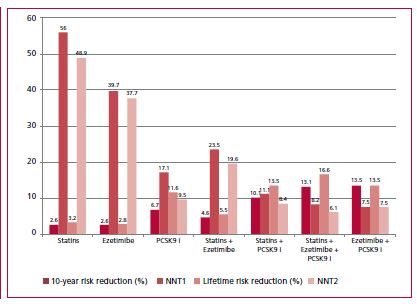
Methods: We conducted a cross-sectional, descriptive and multicenter study. Patients with a history of cardiovascular disease and LDL-C ≥ 55 mg/dL were consecutively included. The 10-year and lifetime risk of recurrent events (myocardial infarction, stroke, or vascular death) were estimated using the SMART-REACH model. By means of a simulation, lipid-lowering treatment was optimized for each patient [using statins, ezetimibe and/or proprotein convertase subtilisin/kexin type 9 inhibitors (PCSK9i)], with estimation of LDL-C reduction, checking if lipid-lowering goal was achieved and calculating the reduction in cardiovascular risk and the corresponding number needed to treat (NNT).
Results: The cohort was made up of 187 patients; mean age was 67.9 ± 9.3 years and 72.7% were men. The calculated 10-year and lifetime residual risks were 37.1 ± 14.7% and 60.3 ± 10.7%, respectively. Overall, treatment was optimized with a single pharmaco logical strategy with statins, ezetimibe or PCSK9i inhibitor in 38.5%, 11.5% and 5.5% of the population, respectively. Optimization based on two treatments was performed in 27.5% (statins + ezetimibe), 7.7% (statins + PCSK9i) and 1.1% (ezetimibe + PCSK9i ) of the cases. In 15 patients, treatment was optimized when the three drugs (statins + ezetimibe + PCSK9i) were considered. Overall,
53.9% and 62.9% of the actions implemented to optimize treatment showed a 10-year or lifetime NNT < 30 to prevent an event,
respectively.
Conclusion: In this study, patients with a history of cardiovascular disease who do not reach LDL-C goal showed significant residual cardiovascular risk. The simulation model showed a significant margin for optimizing treatment, with a marked reduction in residual cardiovascular risk.
Keywords: Residual cardiovascular risk - Cholesterol LDL - Hydroxymethylglutaryl-CoA reductase inhibitors - Ezetimibe - PCSK9
inhibitors.
How to cite this article
Masson W, Barbagelata L. Masson G, Lynch S, Huerin M, Siniawski D. Impact of Optimizing Lipid-Lowering Therapy on Residual Cardiovascular Risk. Rev Argent Cardiol 2023;91:309-16. http://dx.doi.org/10.7775/rac.v91.i5.20666
Downloads
Published
Issue
Section
License
Copyright (c) 2023 Argentine Journal of Cardiology

This work is licensed under a Creative Commons Attribution-NonCommercial-ShareAlike 4.0 International License.