Mid-term Follow-Up of Patients Submitted to Aortic Valve Replacement with Mechanical Prosthesis
pp 187-192
DOI:
https://doi.org/10.7775/rac.v76i3.2405Keywords:
Valve Prosthesis, Survival, Aortic Valve Stenosis, Aortic Valve RegurgitationAbstract
Background
Aortic valve disease is one of the most frequent causes of valve replacement in our environment. This study was performed based on the lack of information related to late outcomes in patients submitted to aortic valve replacement with mechanical prosthesis.
Objective
To assess the mortality, morbidity (major complications) and functional outcomes (clinical improvement) during the follow-up of patients with mechanical prosthesis placed in the aortic position.
Material and Methods
Ninety five patients submitted to aortic valve replacement with mechanical prosthesis were selected. Surgeries were performed between January 1999 and December 2006. Mean follow-up was 4±2.3 years; percentiles 25-75: 2.5-6.3 years. Total follow-up was 427.5 patients/year.
Results
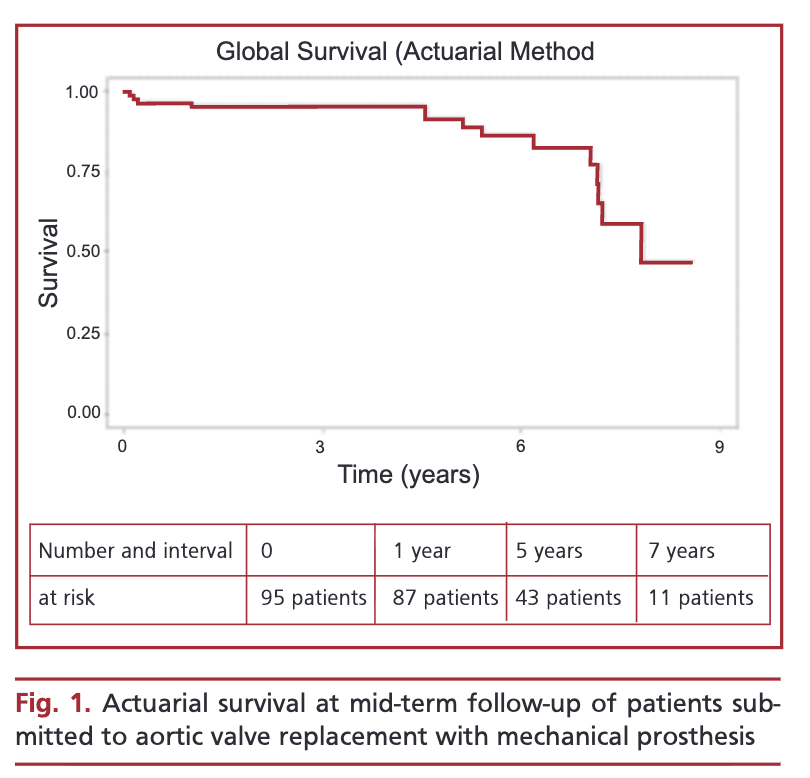
Mean age was 64.5±12.3 years, 61.1% were men. Sixty patients (63%) were in functional class (FC) III-IV prior to surgery. During follow-up, 67 patients (70.5%) were in FC I and 28 (29.5%) in FC II. No patients presented FC III or IV. Mean effective valve area/body surface area was 1.06 cm2/m2. Actuarial survival (Kaplan-Meier) was 95% (95% CI 88-98%) at one year and 89% at 5 years (95% CI 76-95%). Nine deaths (9.5%) were related to this condition. The incidence of complications was as follows: thromboembolism 0.2% patient/year, bleeding 2.3% patient/year, and endocarditis 0.7% patient/year. Re-operation rate was 0.4% patient/year.
Conclusions
These results were similar to those reported in international series in terms of survival and major complications. The number of adverse events observed at mid-term is still high, as it is all around the world.
Downloads
Published
Issue
Section
License
Copyright (c) 2025 Argentine Journal of Cardiology

This work is licensed under a Creative Commons Attribution-NonCommercial-ShareAlike 4.0 International License.