
Coronary Lesions in Kawasaki Disease
pp. 7-11
DOI:
https://doi.org/10.7775/rac.v83.i1.5750Keywords:
Kawasaki Disease, Coronary Aneurysms, Coronary Heart DiseaseAbstract
Introduction: Kawasaki disease, a vasculitis of unknown origin, is currently the main cause of acquired heart disease during childhood and its main sequels are associated with coronary arteries. Therefore, early identification of possible coronary lesions enables adequate treatment to decrease their occurrence.
Objectives: The aims of this study were to determine the probability of coronary injury in patients with Kawasaki disease, to identify the risk factors for developing coronary lesions and the long-term outcome of these patients.
Methods: A total of 245 children with mean age of 3.48 years were diagnosed with Kawasaki disease between October 1988 and December 2013. Age, sex, clinical and laboratory criteria of Kawasaki disease, echocardiographic findings and long-term outcome were analyzed, and the odds ratio was used to assess their participation as probable risk factors for coronary lesions.
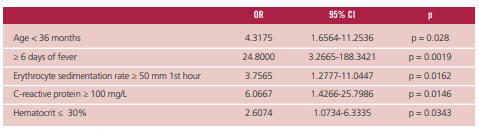
Results: Thirty-nine patients presented coronary lesions: 25 male and 14 female patients with mean age of 2.05 years. Risk factors were: age < 3 years; prolonged fever ≥ 6 days, erythrocyte sedimentation rate > 50 mm/hr; C-reactive protein > 100 mg/L and hematocrit < 30%. Thirteen patients showed transient coronary artery dilation, 12 solitary small or medium-sized aneurysms, 7 multiple coronary aneurysms, 6 giant coronary aneurysms and one myocardial infarction by severe obstructive lesion. In-hospital mortality was 4‰.
Conclusions: Risk of coronary artery lesions in patients with Kawasaki disease was 15.91%. Risk factors were age under 3 years, fever lasting more than 6 days, erythrocyte sedimentation rate > 50 mm/hr; C-reactive protein > 100 mg/L and hematocrit < 30%. In patients with persistent residual coronary lesions treated conventionally there were no adverse events in the mid- and long-term follow-up.
Downloads
Published
Issue
Section
License
Copyright (c) 2025 Argentine Journal of Cardiology

This work is licensed under a Creative Commons Attribution-NonCommercial-ShareAlike 4.0 International License.





