Variables Associated with Improved Left Ventricular Function after Myocardial Revascularization
pp. 51-55
DOI:
https://doi.org/10.7775/rac.es.v84.i1.5652Keywords:
Myocardial revascularization, Ventricular dysfunction, Myocardial ischemiaAbstract
Background: Myocardial revascularization is the treatment of choice in patients with ischemic systolic dysfunction. Left ventricular ejection fraction (LVEF) constitutes a prognostic factor in these patients, so it is of interest to identify the variables related with left ventricular function improvement.
Objective: The aim of this study is to determine the variables associated with improvement of LVEF in patients with ischemic systolic dysfunction undergoing myocardial revascularization. Methods: Patients with LVEF <50% undergoing surgical myocardial revascularization with echocardiographic monitoring ≥6
months were included in the study. The variables associated with LVEF improvement >5% were analyzed.
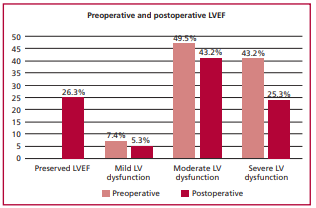
Results: The cohort consisted of 95 patients; 91.6% were men, mean age was 63 years, 40% were diabetic, 27% had previous myocardial infarction and LVEF was 36%±6%. Viability was assessed in 78% of cases. During the immediate postoperative period, 12.6% of patients presented ischemia and 28% low cardiac output. Multivariate analysis revealed that myocardial viability and lack of perioperative ischemia were independent predictors of LVEF improvement.
Conclusions: Myocardial viability and absence of perioperative ischemia were associated with improved LVEF during long-term follow-up.
Downloads
Published
Issue
Section
License
Copyright (c) 2025 Argentine Journal of Cardiology

This work is licensed under a Creative Commons Attribution-NonCommercial-ShareAlike 4.0 International License.