
Remote Mechanisms of Myocardial Protection

pp. 196-201

Authors

  • María A. Goyeneche Institute of Cardiovascular Pathophysiology, (INFICA), Department of Pathology, School of Medicine, University of Buenos Aires, Argentina
  • Martín Donato Full Member of the Argentine Society of Cardiology; Members of the National Scientific and Technical Research Council (CONICET). Institute of Cardiovascular Pathophysiology, (INFICA), Department of Pathology, School of Medicine, University of Buenos Aires, Argentina; Institute of Biochemistry and Molecular Medicine (IBIMOL, UBA-CONICET), School of Medicine and Biochemistry, University of Buenos Aires, Argentina
  • Diamela T. Páez Institute of Cardiovascular Pathophysiology, (INFICA), Department of Pathology, School of Medicine, University of Buenos Aires, Argentina
  • Mariana Garcés Institute of Biochemistry and Molecular Medicine (IBIMOL, UBA-CONICET), School of Pharmacy and Biochemistry, University of Buenos Aires, Argentina
  • Timoteo Marchinni Institute of Biochemistry and Molecular Medicine (IBIMOL, UBA-CONICET), School of Pharmacy and Biochemistry, University of Buenos Aires, Argentina
  • Virginia Pérez Institute of Cardiovascular Pathophysiology, (INFICA), Department of Pathology, School of Medicine, University of Buenos Aires, Argentina; Institute of Biochemistry and Molecular Medicine (IBIMOL, UBA-CONICET), School of Medicine and Biochemistry, University of Buenos Aires, Argentina
  • Martín Grispun Institute of Cardiovascular Pathophysiology, (INFICA), Department of Pathology, School of Medicine, University of Buenos Aires, Argentina
  • Julieta del Mauro Chair of Pharmacology, School of Pharmacy and Biochemistry, University of Buenos Aires, Argentina
  • Christian Hocht Chair of Pharmacology and Biochemistry, Unibersity of Buenos Aires, Argentina
  • Pablo Evelson Members of the National Scientific and Technical Research Council (CONICET). Institute of Biochemistry and Molecular Medicine (IBIMOL, UBA-CONICET), School of Pharmacy and Biochemistry, University of Buenos Aires, Argentina
  • Ricardo J. Gelpi Full Member of the Argentine Society of Cardiology; Member of the National Scientific and Technical Research Council (CONICET); Institute of Cardiovascular Pathophysiology, (INFICA), Department of Pathology, School of Medicine, University of Buenos Aires, Argentina; Instituto de Bioquímica y Medicina Molecular (IBIMOL, UBA-CONICET), Facultad de Medicina, Universidad de Buenos Aires; nstitute of Biochemistry and Molecular Medicine (IBIMOL, UBA-CONICET), School of Medicine and Biochemistry, University of Buenos Aires, Argentina

DOI:

https://doi.org/10.7775/rac.es.v84.i3.8074

Keywords:

Myocardial Infarction - Myocardial Protection - Ischemic Preconditionin

Abstract

Background: Remote ischemic preconditioning (rIPC) has been suggested to reduce infarct size through the activation of a parasympathetic neural pathway. However, the intracellular mechanisms responsible for this protection remain unclear.


Objective: The aim of this study was to describe some of the intracellular protective signals activated at the cardiac level by rICP prior to myocardial ischemia.


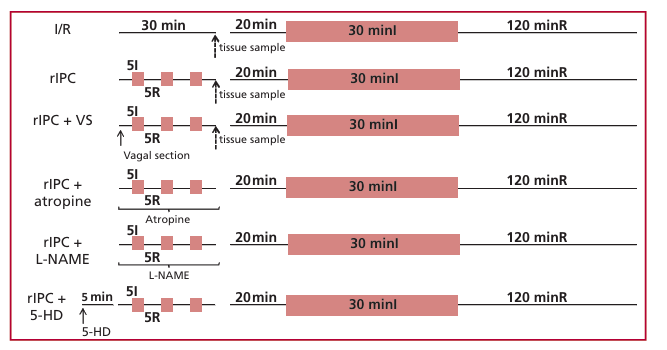
Methods: Isolated rat hearts were subjected to 30 minutes of global ischemia and 120 minutes of reperfusion (I/R). In a second group, before the isolation of the heart, a rIPC protocol (three cycles of left femoral artery ischemia/reperfusion) was performed, followed by the I/R protocol. Additionally, four experimental groups were studied, in which prior to the rIPC protocol a bilateral cervical vagotomy [VS (vagal section)] was performed or atropine (muscarinic receptor blocker), L-NAME (NO synthesis inhibitor), and 5-HD (mK+ATPchannel blocker) was administered, respectively. Infarct size and eNOS phosphorylation were measured in I/R, rIPC, and VS groups. Finally, mitochondrial H2O2 production was assessed.


Results: Remote ischemic preconditioning significantly decreased infarct size and this effect was abolished by VS and atropine, L-NAME, and 5-HD treatments. Furthermore, rIPC increased eNOS phosphorylation and this effect was abolished by VS. Finally, rIPC increased the mitochondrial H2O2 production, and this effect was also abolished by VS.


Conclusions: Remote ischemic preconditioning activates a muscarinic vagal pathway involving eNOS phosphorylation, opening of mitochondrial mK+ATPchannels, and the production of mitochondrial H2O2.
.
Published

2025-07-02

Issue

Section

ORIGINAL ARTICLES

Most read articles by the same author(s)

1 2 3 4 5 6 7 > >>
