Long-term Outcomes of Coronary Artery Bypass Surgery According to the Presence or Absence of Left Main Coronary Artery Disease
pp. 179-184
DOI:
https://doi.org/10.7775/rac.es.v90.i3.20518Keywords:
Myocardial Revascularization - Follow-Up Studies - Coronary Artery Bypass - Left Main Coronary Artery DiseaseAbstract
Background: Coronary artery bypass grafting (CABG) has modified the natural evolution of patients with left main coronary artery (LMCA) disease. There is little information in our setting regarding the mid- and long-term follow-up of operated patients.
Objective: The aim of this study was to evaluate the implication of LMCA disease in the long-term evolution of patients operated on with CABG, and to assess the mortality and incidence of myocardial infarction (AMI) and/or stroke.
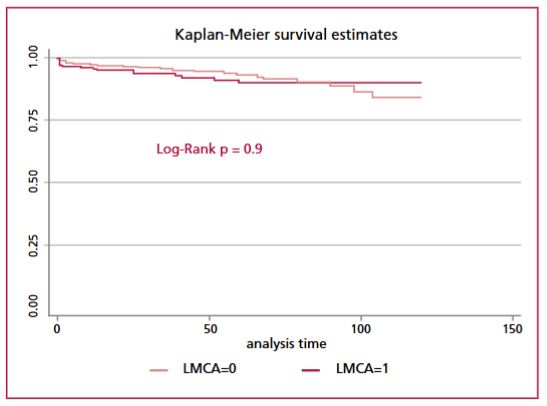
Results: Follow-up was completed in 438 patients (95.6%) with a median of 58 months [interquartile range (IQR) 35-88 months]. Actuarial survival at 10 years was 91.8% for the entire population, with no significant differences between the LMCA group (91.57%) vs. the non-LMCA group (91.86%), HR 1,008 95% CI 0.38-2.65, p=0.98. In multivariate analysis, preoperative left ventricular ejection fraction (HR = 0.95; 95% CI 0.93-0.97; p < 0.001), age (HR 1.1, 95% CI 1.04-1.13, p<0.001) and
non-elective priority of surgery (HR=3.71; 95% CI 1.3-10.35; p=0.01) were independent predictors of long-term mortality. AMI-free survival was 96.8% (LMCA 94% vs. non-LMCA 97.4%, p=0.8) and freedom from stroke was 98% (LMCA 97.8% vs. non-LMCA 98.1 %, p=0.8).
Conclusion: In patients undergoing CABG, the presence of LMCA disease did not increase the rate of hard events (death, AMI, and stroke) at the long-term follow-up. The results obtained in this series of patients are similar to those published in the international literature used to develop myocardial revascularization guidelines.
How to cite this article:
Vaccarino GN, Melchiori R, Gutiérrez G, Clusa M, Fernández H, Hita A, et al. Long-term Outcomes of Coronary Artery Bypass Surgery According to the Presence or Absence of Left Main Coronary Artery Disease. Rev Argent Cardiol 2022;90:179-84. http://dx.doi.org/10.7775/rac.v90.i3.20518