Prevalence of Early B-Cell Factor 1 Gene rs4704963 Single Nucleotide Polymorphism (T>C) in a Population of Type 2 Diabetic Patients with Obesity
pp 310-316
DOI:
https://doi.org/10.7775/rac.es.v86.i5.13866Keywords:
Diabetes, Obesity, EBF1 gene, Polymorphism, Acute ischemic syndrome, StressAbstract
Background: Previous studies established that in a population with exacerbation of type 2 diabetes with obesity (DBT+Ob) suffering from stress, the prevalence of early B-Cell Factor 1 (EBF1) gene rs4704963 single nucleotide polymorphism (SNP) (T>C) is 16.5%.
Objectives: The aim of this study was to determine the prevalence of this SNP in patients with DBT+Ob attending Hospital Ramos Mejía of the Autonomous City of Buenos Aires and to ascertain whether this polymorphism is associated with stress or acute coronary events.
Methods: An observational, prospective study on the prevalence of rs4704963 SNP was performed in 53 patients with DBT+Ob and body mass index between 28 and 41, seen in Hospital Ramos Mejía for a period of 15 months. Each patient was evaluated with a stressful life events scale and a perceived stress scale. The chi-square test and odds ratio (OR) were used for statistical analysis.
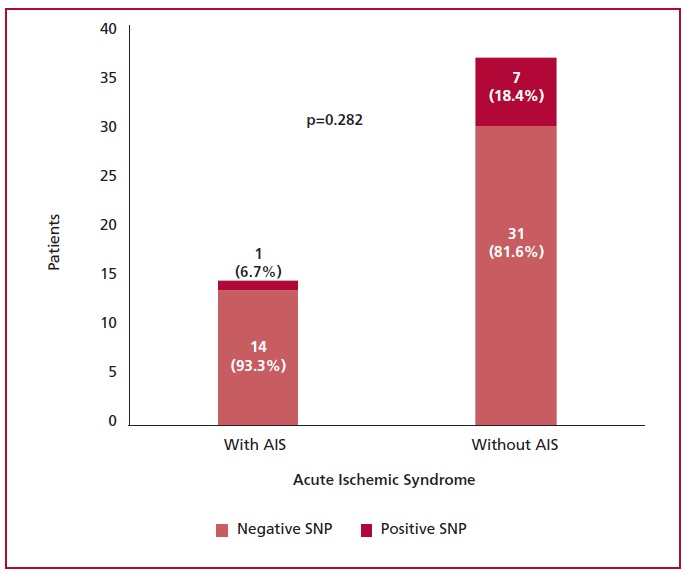
Results: A total of 53 patients were included in the study. Mean population age was 60.2±9.77 years and 47.2% were men. Among these patients, 8 (15.1%) presented SNP and all were heterozygous. Fifteen patients (28.3%) had acute ischemic syndrome (AIS), and among these, only one (6.6%) had SNP. No statistically significant relationship was found between the presence of SNP and AIS(p=0.282). Fourteen patients (26.4%) presented moderate or severe chronic stress, and there was no relationship between this finding and the presence of SNP (p=0.979).
Conclusions: The prevalence of EBF1 gene rs4704963 SNP (T>C) in the DBT+Ob population was 15.1%. No statistically significant association was found between SNP and stress or AIS.
Downloads
Published
Issue
Section
License
Copyright (c) 2025 Argentine Journal of Cardiology

This work is licensed under a Creative Commons Attribution-NonCommercial-ShareAlike 4.0 International License.