Side Branches and Coronary Stenting: Early Angiographic Changes
pp 453-456
DOI:
https://doi.org/10.7775/rac.v65i4.3705Keywords:
Stents, Side branchesAbstract
Background
The aim of this study was to assess the immediate effects of the deployment of Palmaz-Schatz and Gianturco-Roubin stents on the flow of side branchs arising from the stented arterial segments and their relationship with preexistent ostial disease, dissection or thrombus.
Methods
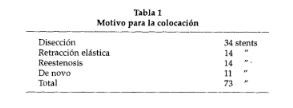
Seventieth-third stents were deployed in 66 patients overlaying a total of 123 side branchs that were classified into three groups: type A (luminal diameter > 1 mm without ostial stenosis), type B (luminal diameter >_ 1 mm with ostial stenosis) and type C (luminal diameter < 1 mm). Flow impairment was defined as a regression of one or more points in the TIMI scale (0, 1, 2 or 3). The last con-trol coronary angiogram was performed 50 ± 10minutes after the last insufflation.
Results
Flow impairment was present in 6.06% of type C,10.7% of type B and none of type A side branchs; the difference between types A and B was not statistically significant, but there was a trend towards occlusion in vessels with ostial stenosis. The presence of thrombus determined a significant impact in smaller side branchs (type C) (p < 0.0068). Dissection proved to be of no statistical importance on outcome.
Conclusions
Stenting with Palmaz-Schatz or Gianturco-Roubin devices does not modify flow in the majority of the side branchs arising from the stented segments; though major vessels with ostial disease and smaller vessels in the presence of thrombus merit greater attention.
Downloads
Published
Issue
Section
License
Copyright (c) 2026 Argentine Journal of Cardiology

This work is licensed under a Creative Commons Attribution-NonCommercial-ShareAlike 4.0 International License.