
Implementation of an Ambulatory Percutaneous Coronary Intervention Program in Higher Risk Patients
pp. 177-184
DOI:
https://doi.org/10.7775/rac.es.v86.i3.12724Keywords:
Coronary Angioplasty - Ambulatory Care - Ambulatory Surgical Procedures/economicsAbstract
Background: The implementation of ambulatory percutaneous coronary intervention (APCI) programs in patients with elective treatment is a feasible and safe strategy. However, the information about its implementation for same-day discharge after the procedure in higher risk patients is limited and, according to publications, may not reflect the current state of coronary percutaneous intervention.
Objective: The aim of this study was to evaluate the safety and feasibility of an APCI program for same-day discharge in elective higher risk patients.
Methods: This was an observational, single-center study including patients who underwent elective percutaneous coronary intervention between January 2009 and March 2017. Presence of increased APCI risk was defined according to the Society for Cardiovascular Angiography and Interventions consensus on hospital length of stay after percutaneous coronary intervention. The safety of the intervention in APCI patients (intervention cohort) was evaluated against a preintervention cohort of elective patients assessed between January 2009 and October 2015. To evaluate feasibility, the intervention cohort was divided
into two groups according to hospital stay: patients discharged on the same day of the procedure (same-day discharge group, SDDG) and those with overnight hospitalization (hospitalization group, HG).
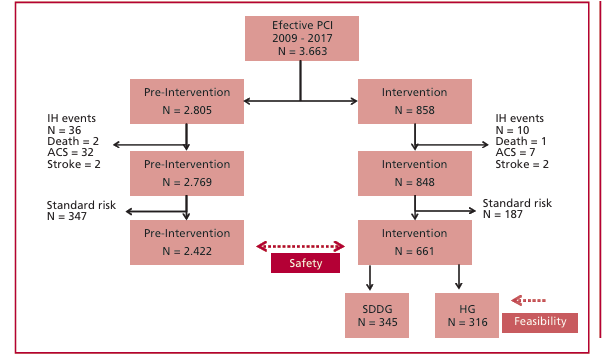
Results: The study included 3,663 patients, among which 2, 422 presented higher risk for APCI in the preintervention cohort and 661 in the intervention cohort. The prevalence of death/acute myocardial infarction/stroke at 7 days was similar in both groups (intervention cohort 0.5% vs. preintervention cohort 0.5% (HR 1.04, 95% CI 0.29-3.75; p=0.94). No differences were observed in the need for rehospitalization (intervention cohort 0.9% vs. preintervention cohort 1.7% (HR 0.53, 95% CI 0.22-1.27; p=0.15). In the feasibility analysis, the SDDG represented 52.1% of the intervention cohort, with a significant 73% length of stay reduction (HG 19.4 h, IQR 17.22-22.7 vs. SDDG 7.27 h, IQR 5.8-9.1; p<0.0001) and 23% cost reduction. The length of hospital stay in the SDDG increased in APCI patients with higher risk factor (RF) burden: 1 RF: 6.8 h, IQR 5.6-8.1; 2 RF: 7.1 h, IQR 5.7-9.02; ≥3 RF: 7.7 h, IQR 6.4-11.5; ptrend 0.002. In the HG, the causes for overnight observation were: 30.4% comorbidities, 20.3% complex interventions and 23.4% social causes.
Conclusion: The implementation of our APCI program in this population of patients was associated with similar rates of major events and rehospitalization than that of patients undergoing a standard procedure. The reduction in hospital length of stay and costs could have a favorable impact on the institution’s operative efficiency.
Downloads
Published
Issue
Section
License
Copyright (c) 2018 Argentine Journal of Cardiology

This work is licensed under a Creative Commons Attribution-NonCommercial-ShareAlike 4.0 International License.





