
Development and External Validation of a Predictive Score of Postoperative Mediastinitis in Cardiovascular Surgery Derived from the XVI CONAREC Multicenter Registry
pp 281-286
DOI:
https://doi.org/10.7775/rac.es.v87.i4.15329Keywords:
Cardiac Surgical Procedures/adverse effects, Postoperative complications, Mediastinitis, Predictive Value of Tests, Risk AssessmentAbstract
Background: The aim of this analysis was to define independent predictive variables for the development of mediastinitis after cardiovascular surgery and develop a validated score to stratify the risk of its manifestation.
Methods: Data were retrieved from the XVI CONAREC study comprising adults undergoing cardiovascular surgery between September 2007 and October 2008 in 49 centers of 16 provinces in Argentina. Mediastinitis was defined as the presence of clinical signs attributable to the condition or positive cultures. Epidemiological and clinical variables, type of surgery, intraoperative and postoperative variables and complementary tests were evaluated. A multiple logistic regression model was used to identify the independent variables associated with perioperative mediastinitis. A two-tailed alpha error <0.05 was considered statistically significant. A score was built and was externally validated in patients from other surgical centers.
Results: A total of 2,553 patients were analyzed: 1,465 (57.4%) undergoing coronary artery bypass graft surgery, 359 (14.1%) aortic valve replacement, 169 (6.6%) mitral valve surgery, 312 (12.2%) combined surgery and 248 (9.7%) other procedures,. The overall incidence of mediastinitis was 1.88%. The variables associated with the development of mediastinitis were: smoking (OR: 2.3; 95%CI 1.1-5.1; p=0.02), severe left ventricular dysfunction (OR: 2.8; 95% CI 1.3-6.2; p=0.001), reoperation (OR: 4.6; 95% CI 1.8-11.3;p=0.01) and postoperative renal failure (OR: 4.3; 95% CI 1.9-9.6; p=0.0001). A risk score was built assigning 1 point for severe
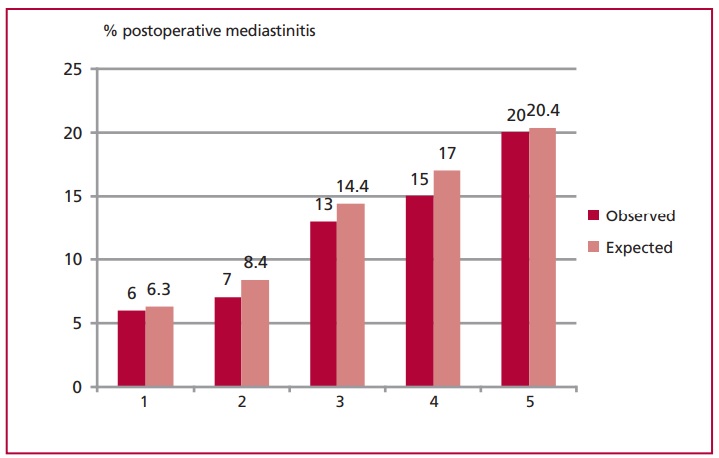
left ventricular dysfunction, 1 point for history of smoking, 2 points for the development of renal failure and 2 points for need for reoperation. The area under the ROC curve for mortality was 0.72 (95% CI 0.64-0.81; Hosmer Lemeshow test p=0.9). The external validation was performed on 1,657 patients with mean age 62.8±13.3 years. The incidence of mediastinitis was 1.6%. The area under the ROC curve for the development of mediastinitis was 0.70 (95% CI, 0.58-0.80; p=0.001).
Conclusions: A predictive score for the development of postoperative mediastinitis after cardiovascular surgery is relevant for daily practice, both for the prevention as for the early detection of this severe complication.
Downloads
Published
Issue
Section
License
Copyright (c) 2025 Argentine Journal of Cardiology

This work is licensed under a Creative Commons Attribution-NonCommercial-ShareAlike 4.0 International License.





