Stress Echo Comprehensive Software (SECS) for state-of-art ABCDE protocol
pp. 457-462
DOI:
https://doi.org/10.7775/rac.es.v87.i6.16647Keywords:
Echocardiography, Stress – SoftwareAbstract
Background: Several specialized softwares are commercially available for the elective storage of stress echo (SE) data. State-of-the art SE is based upon novel parameters in addition to regional wall motion.
Objective: To develop a novel software for SE data storage and reporting.
Methods: We developed the prototype of a SE Comprehensive Software (SECS) with a minimum data set eventually allowing stand
ardized collection of data. The software runs with medium-low performance computers as well as with the most popular operating
systems (Windows, MAC OS and Linux). The export functions towards widely accepted formats allow easy data sharing. The soft
ware is able to generate a customized report which can be expanded in PDF and comma-separated values formats.
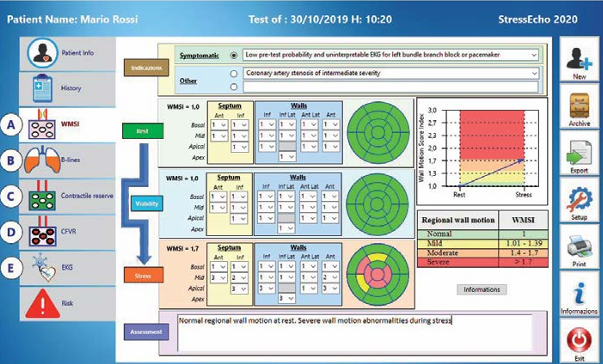
Results: The program prototype data entry requires < 2 min per study. The main pages focus on the 5 steps of ABCDE-SE: step A
(regional wall motion); step B (B-lines with 4-site simplified scan); step C (contractile reserve with force derived from systolic blood
pressure and end-systolic volume); step D (Doppler-based coronary flow velocity reserve in left anterior descending coronary artery); step E (EKG-based chronotropic reserve measured as peak/rest heart rate). The final page graphically summarizes the ABCDE information in a risk prediction model (cardiac death rate per year, from low risk < 1% to high risk > 3 %).
Conclusion: SECS may provide a suitable infrastructure for an advanced clinical and research application, with simple graphic for
mat and convenient reporting option. It may represent a trade-off between exhaustive information required by scientific standards and smooth workflow priority of busy, high volume, clinically-driven activities. Large scale validation and adaptation from users’ feedback is necessary prior to dissemination on demand.
Downloads
Published
Issue
Section
License
Copyright (c) 2019 Argentine Journal of Cardiology

This work is licensed under a Creative Commons Attribution-NonCommercial-ShareAlike 4.0 International License.