
The 21-Day Plan: Anthropometric, Biochemical, and Cardiovascular Risk Assessment After a Lifestyle Intervention in Entre Ríos, Argentina
pp. 354-361
DOI:
https://doi.org/10.7775/rac.es.v93.i5.20926Keywords:
Cardiovascular risk, Lifestyle Medicine, Cholesterol, High-sensitivity CRP, Atherogenic indexAbstract
Background: The development of chronic noncommunicable diseases (NCDs) is largely associated with modifiable behavioral risk factors such as unhealthy diets, physical inactivity, smoking, excessive alcohol consumption, inadequate restorative sleep, poor stress management, and low social connectivity. Lifestyle programs that promote the systematic incorporation of healthy habits are essential to prevent and control NCDs in Latin America.
Objective: To determine the impact on anthropometric and biochemical parameters, and overall cardiovascular risk before and after a 21-Day Plan consisting of a prescribed plant-based diet and regular and personalized physical activity.
Methods: The 21-Day Plan consisted of a 21-day prescription of a plant-based diet combined with personalized physical activity, as well as psychological and spiritual support. It aimed to assess whether this intervention could modify the aforementioned parameters in the short term to confirm its benefits and potentially incorporate it as a long-term lifestyle. Data were collected from patients enrolled between March 2020 and October 2023, including body mass index (BMI) and laboratory parameters measured pre- and post-intervention.
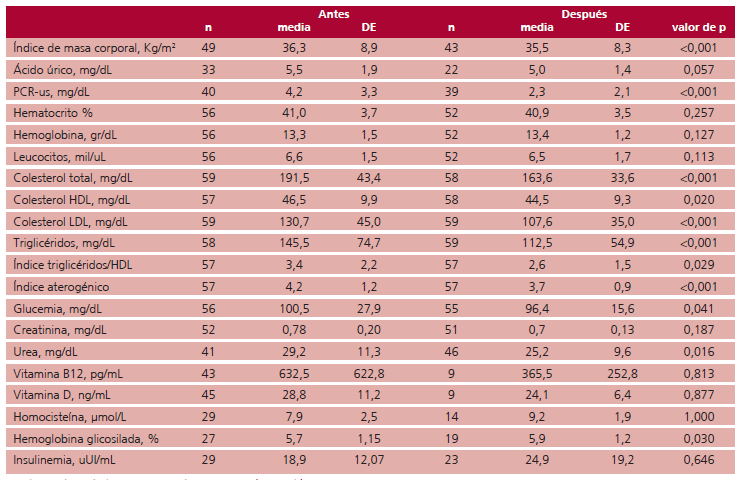
Results: Fifty-nine patients were included in the study (mean age, 47.5±12.6 years), 72.8% women. After 21 days of lifestyle intervention, BMI significantly decreased from 36.3 to 35.5 kg/m2 (p<0.001), total cholesterol from 191.5 to 163.6 mg/dL (p<0.001), low-density lipoprotein cholesterol (LDL-C) from 130.4 to 107.6 mg/dL (p<0.001), triglycerides from 145.5 to 112.5 mg/dL (p<0.001), atherogenic index from 4.2 to 3.7 mg/L (p<0.001), high sensitivity C-reactive protein (hs-CRP) from 4.2 to 2.3 mg/dL (p<0.001). Overall 10-year cardiovascular risk did not show statistically significant changes.
Conclusion: This lifestyle intervention was effective in significantly reducing anthropometric and biochemical parameters in the short term. A larger sample size, longer intervention duration, and longer follow-up are needed to demonstrate a significant reduction in long-term cardiovascular risk.
Downloads
Additional Files
Published
Issue
Section
License
Copyright (c) 2025 Argentine Journal of Cardiology

This work is licensed under a Creative Commons Attribution-NonCommercial-ShareAlike 4.0 International License.





