
Relationship Between Body Fat and Morbidity and Mortality in Cardiac Surgery
pp. 131-136
DOI:
https://doi.org/10.7775/rac.es.v88.i2.17214Keywords:
Cardiac Surgical Procedures, Obesity, Body Mass Index, Body Composition, Prognosis.Abstract
Objective: There is a potentially protective effect of obesity when it coexists with cardiovascular disease. This is known as the “obesity paradox”, which might be explained by anthropometric measurements as an unreliable marker of body fat.
Objective: The aim of this study was to estimate body fat with a non-invasive method and study its relationship with morbidity and mortality in cardiac surgery.
Methods: We conducted a prospective and observational study in adult patients undergoing cardiac surgery. Demographic, anthropometric and clinical variables together with the estimation of body composition using bioelectrical impedance analysis were used to analyze their association with length of hospital stay and adverse events after cardiac surgery.
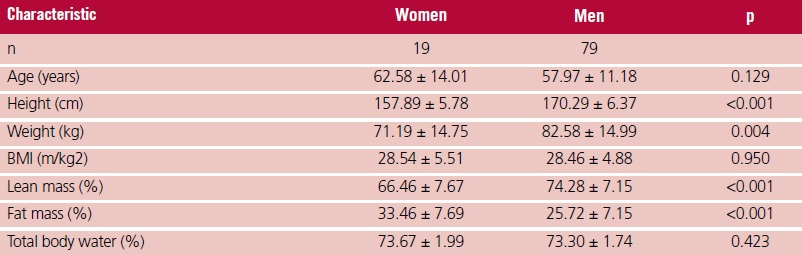
Results: The analysis of 98 patients revealed a direct relationship between the percentage of body fat and length of hospital stay, independently of age, sex, body mass index and preoperative risk (coefficient of 0.27, p = 0.021). In addition, patients who had mediastinitis showed significantly higher body fat (31.55 ± 0.64% vs. 27.13 ± 7.9%, p <0.001), and patients who died had a tendency to have larger fat mass (36.05 ± 3.19% vs. 27.20 ± 7.82%, p = 0.08).
Conclusion: Increased body fat assessed with bioelectric impedance analysis was related to higher morbidity in cardiac surgery. Although this result is biologically plausible, larger studies are necessary in order to definitively establish the “body mass index paradox”.
Downloads
Published
Issue
Section
License
Copyright (c) 2025 Argentine Journal of Cardiology

This work is licensed under a Creative Commons Attribution-NonCommercial-ShareAlike 4.0 International License.





