
Association Between Bicuspid Aortic Valve and Ascending Aorta Morphology
pp. 329-332
DOI:
https://doi.org/10.7775/rac.es.v88.i4.18556Keywords:
Aorta - Aortic Valve, Bicuspid - Aortic Valve/abnormalities - Aortic Valve Stenosis - Aortic Valve InsufficiencyAbstract
Background: Bicuspid aortic valve (BAV) occurs in 2% of the population, and is divided into 3 morphological groups: right and left coronary cusp (RL), right coronary and non-coronary cusp (RN), and left coronary and non-coronary cusp (LN) fusion patterns.
Objective: The aim of the study was to evaluate the association between bicuspid aortic valve morphology and ascending aorta morphology.
Methods: This was a descriptive-analytical study carried out in 200 patients. A questionnaire collected echocardiographic findings and variables. SPSS 22 was used for statistical analysis.
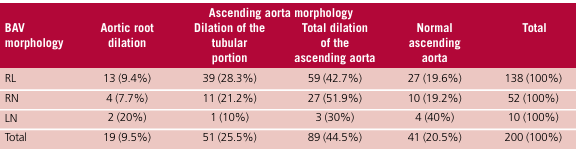
Results: The study enrolled 139 men (69.5%) and 61 women (30.5%). Right and left coronary cusp fusion (69%) and total dilation of the ascending aorta (44.5%) were the most common morphologies.
Conclusion: Right and left coronary cusp fusion was the most prevalent morphology and total dilation of the aorta and abnormal aortic valve function were more frequent in RL cusp fusion.
Downloads
Published
Issue
Section
License
Copyright (c) 2020 Argentine Journal of Cardiology

This work is licensed under a Creative Commons Attribution-NonCommercial-ShareAlike 4.0 International License.





