
Stroke Prevention in Atrial Fibrillation. Findings from the GLORIA-AF Registry
pp. 282-288
DOI:
https://doi.org/10.7775/rac.es.v88.i4.18386Keywords:
Anticoagulants / administration & dosage - Administration, Oral - Atrial Fibrillation Stroke/prevention and controlAbstract
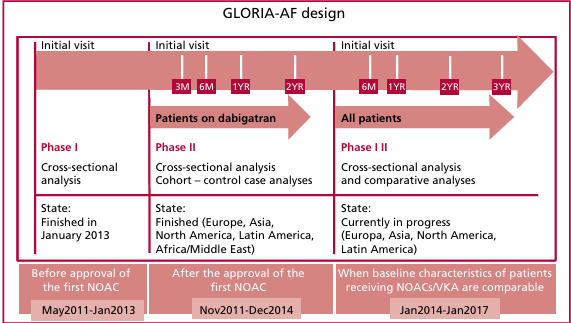
Background: The Global Registry on Long-Term Oral Antithrombotic Treatment in Patients with Atrial Fibrillation (GLORIA-AF) is a multinational, prospective, 3-phase study to establish the safety and efficacy of dabigatran in patients with newly diagnosed nonvalvular atrial fibrillation at risk of stroke. Phase II began when dabigatran, the first non-vitamin K antagonist oral anticoagulant (NOAC) became available.
Objectives: The aim of this registry was to describe Phase II baseline clinical data in the general population and the 2-year follow-up of patients treated with dabigatran.
Methods: Among 15,644 patients enrolled in the study, 15,308 were eligible and 4,873 received dabigatran. Atrial fibrillation characteristics, follow-up findings and concomitant diseases were recorded and analyzed using descriptive statistics.
Results: Forty-five percent of eligible patients were women and median age was 71.0 years (interquartile range: 64-78 years). Patients were from Europe (47.9%), North America (22.2%), Asia (20.1%), Latin America (6.0%), and the Middle East/Africa (3.9%). Most of them had high risk for stroke (CHA2DS2-VASc score ≥2; 86.1%) and 13.9% had moderate risk (CHA2DS2-VASc score=1). In80.3% of cases, patients received oral anticoagulants: 47.9% NOACs and 32.4% vitamin K antagonists (VKAs); 12.0% received antiplatelet agents and 7.6% did not receive antithrombotic treatment. At the 2-year follow-up, 70.5% remained on dabigatran.
Conclusions: Data from the GLORIA-AF Phase II registry showed that in nonvalvular AF, NOACs have been highly adopted in clinical practice, becoming more frequently prescribed than VKAs. Worldwide, however, a large proportion of patients have remained undertreated.
Downloads
Published
Issue
Section
License
Copyright (c) 2020 Argentine Journal of Cardiology

This work is licensed under a Creative Commons Attribution-NonCommercial-ShareAlike 4.0 International License.





