Reperfusion Times in a Telemedicine-guided Program for the Management of ST-segment Elevation Myocardial Infarction in the Province of La Pampa
pp. 268-273
DOI:
https://doi.org/10.7775/rac.es.v90.i4.20536Keywords:
ST-Segment Elevation Myocardial Infarction - Thrombolysis - Angioplasty - TelemedicineAbstract
Background: Timing of medical care is a relevant factor for ST-segment elevation myocardial infarction (STEMI) mortality.
Objectives: The aim of the present study is to evaluate reperfusion times in STEMI patients participating in a telemedicinebased cardiology care program in the province of La Pampa during the period between August 2018 and December 2021.
Methods: This program consists of a protocol for the management of patients with acute coronary syndrome (ACS) in the different locations of the province, with 24-hour remote assistance provided by cardiologists including both diagnostic support and coordination of on-site thrombolysis.
Results: Of a total of 72 STEMI patients evaluated, 44 received thrombolysis as reperfusion therapy, 25 received primary percutaneous coronary intervention, and 3 received thrombolysis followed by rescue percutaneous coronary intervention. Of the 47 subjects who received thrombolysis, only 5 required to be transferred to the referral center for this procedure.
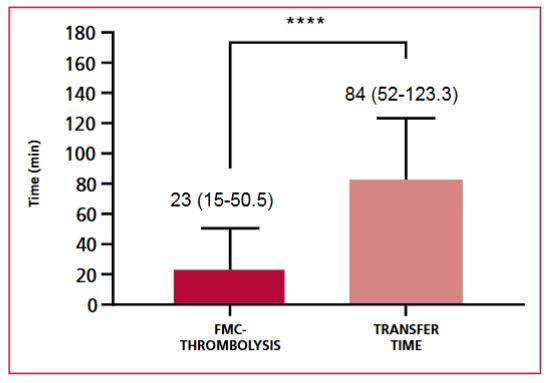
Median door-to-needle time was 24 minutes and door-to balloon-time was 105 minutes. Twenty-five percent of the subjects had a door-to-balloon time <90 minutes and 53.2% fulfilled a door-to-needle time <30 minutes.
Conclusions: The implementation of a telemedicine-guided program for decentralized management of STEMI patients was associated with a high percentage of compliance with the goals of implementing fibrinolytic-based reperfusion therapy.
How to cite this article:
Kohan MR, Messler V, Buffa H, Fernández R, Fernández Estaiye LM, Pachado JG, et al. Reperfusion Times in a Telemedicine-guided Program for the Management of ST-segment Elevation Myocardial Infarction in the Province of La Pampa. Rev Argent Cardiol 2022;90:268-73. http://dx.doi.org/10.7775/rac.v90.i4.20536