
A Preliminary Study of the Phenotype-Genotype Correlation in Cardiomyopathies in Patients Referred to a Tertiary Healthcare Center in the Suburbs of Buenos Aires
pp. 51-65
DOI:
https://doi.org/10.7775/rac.es.v91.i1.20598Keywords:
Cardiomyopathies, Cardiomyopathy Hypertrophic/genetics, Sarcomeres, Genetic Association Studies, Genetic TestingAbstract
Background: Cardiomyopathies are defined as a disorder of the myocardium in which the heart muscle is structurally and functionally abnormal, in the absence of coronary artery disease, hypertension (HT), valvular heart disease and congenital heart disease. These diseases are relatively common and a major cause of morbidity and mortality worldwide. Although genetic testing is recommended for family screening, lack of solid data on specific genotype-phenotype associations has reduced its impact on clinical management.
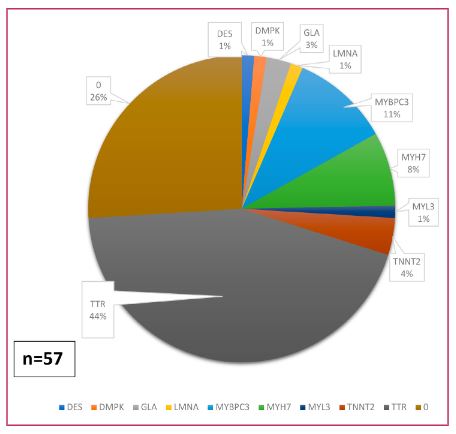
Objectives: This study aims to analyze the frequency of mutations in a population of patients with cardiomyopathy referred to a tertiary healthcare center and to analyze the genotype-phenotype correlation of the identified mutations.
Methods: We prospectively included 102 patients with suspected familial hypertrophic cardiomyopathy (HCM), 70 of which were index cases, from an ambispective cohort of patients with cardiomyopathies treated in a tertiary healthcare public hospital in the province of Buenos Aires, from January 2012 to August 30, 2022.
Results: It was confirmed that molecular testing guided by the Mayo Score provided high probability of detecting mutations. Molecular testing proved to be important due to the phenotypic and genotypic overlap in cardiomyopathies.
Conclusions: Understanding the causative genetic variant, nowadays, does not affect the clinical anagement of most HCM patients, but is helpful in a small group of genes with treatment options.
How to cite this article:
Streitenberger G, Reyes GR, Velazco MP, Pasquevich V, De Santos M, Granillo Fernández M et al. A Preliminary Study of the Phenotype-Genotype Correlation in Cardiomyopathies in Patients Referred to a Tertiary Healthcare Center in the Suburbs of Buenos Aires. Rev Argent Cardiol 2023;91:51-65
https://doi.org/10.7775/rac.v91.i1.20598
Downloads
Published
Versions
- 2023-02-27 (2)
- 2023-02-23 (1)
Issue
Section
License
Copyright (c) 2023 Argentine Journal of Cardiology

This work is licensed under a Creative Commons Attribution-NonCommercial-ShareAlike 4.0 International License.





