Characteristics and Evolution of Cardiogenic Shock According to Gender in Latin America. LATIN Shock Registry Data
pp. 403-409
DOI:
https://doi.org/10.7775/rac.es.v92.i6.20842Keywords:
Cardiogenic shock, Myocardial Infarction, Gender, RegistryAbstract
Background: Cardiogenic shock (CS) as a complication of myocardial infarction is a condition with high mortality that, due to biological or equity differences, may have different characteristics according to gender.
Objectives: The aim of this study was to evaluate whether there are differences in the presentation, clinical evolution and treatment of patients with CS, according to gender.
Methods: We analyzed the patients of the LATIN Shock registry and evaluated whether there were differences according to gender.
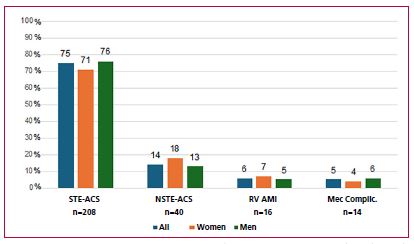
Results: A total of 278 patients (30% women) were included. Seventy-five percent of patients presented ST-segment elevation acute coronary syndrome. Women were older and men were heavier smokers, and there were no differences in the prevalence of other cardiovascular risk factors, history, or comorbidities between genders. Revascularization was similar in men and women (86%) and there were no differences in the indication for pulmonary catheterization (11% vs. 20%, p=0.082). Women received less mechanical support with intra-aortic balloon counterpulsation (14% vs. 26%, p=0,032), while use of other mechanical support procedures was scarce, only in 1% of women and in 3% of men (p=0.678). Mortality in women was 48% vs. 54% in men, not reaching statistical significance (p=0.470).
Conclusions: Women with CS due to infarction are older and receive similar treatment except for mechanical supports, which are more frequently used in men. In our study there were no significant differences in mortality according to gender, which was high in both groups.
How to cite this article:
Castillo Costa Y, Delfino F, Macías J, Quintana M, Adamowski M, Rodríguez Caballero F, et al. Characteristics and Evolution of Cardiogenic Shock According to gender in Latin America. LATIN Shock Registry Data. Rev Argent Cardiol 2024;92:403-409. http://dx.doi.org/10.7775/rac.v92.i6.20842
Downloads
Published
Issue
Section
License
Copyright (c) 2024 Argentine Journal of Cardiology

This work is licensed under a Creative Commons Attribution-NonCommercial-ShareAlike 4.0 International License.