
Probable Arrhythmic Syncope: A Conversation With Artificial Intelligence
pp. 146-153
DOI:
https://doi.org/10.7775/rac.es.v94.i2.20994Keywords:
Artificial intelligence, Clinical reasoning, Arrhythmic syncope, Bayesian analysis, Cardiovascular geneticsAbstract
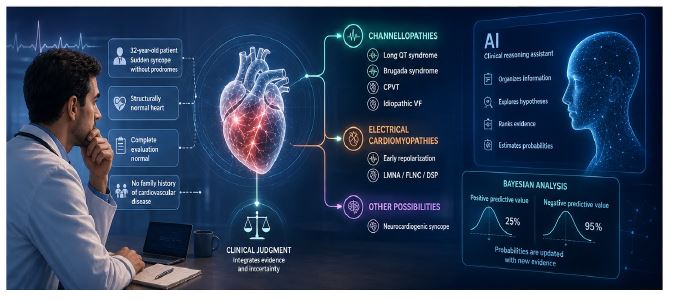
The integration of artificial intelligence (AI) into clinical practice has led to the development of new tools for literature searches, knowledge organization, and decision-making support. However, its true potential emerges when it is integrated into a dynamic reasoning process, similar to a clinical discussion between colleagues.
Based on a case of probable arrhythmic syncope in a young patient with a structurally normal heart, we developed a structured conversation with AI that focuses on differential diagnosis, genetic testing, and risk stratification. The analysis applies Bayesian models to estimate the predictive value of genetic tests and their impact on therapeutic decisions, such as the need for an implantable cardiac defibrillator.
The conversation highlights the strengths and limitations of AI, as it facilitates access to information and the structuring of reasoning, while also revealing the reliance on assumptions and the uncertainty of certain parameters. In high-pressure scenarios, the prioritization of evidence and the contextual interpretation of data prove decisive.
In conclusion, integrating AI into a clinical conversation is a valuable strategy for exploring and validating medical reasoning. However, the ultimate decision remains contingent on clinical judgment, which serves as a unifying force amid complexity and ambiguity.
Downloads
Published
Issue
Section
License
Copyright (c) 2026 Argentine Journal of Cardiology

This work is licensed under a Creative Commons Attribution-NonCommercial-ShareAlike 4.0 International License.





