Distance Education in Cardiology
pp 651-657
DOI:
https://doi.org/10.7775/rac.v65i6.3799Keywords:
Continuous medical education, Distance education, Educational technologyAbstract
Background
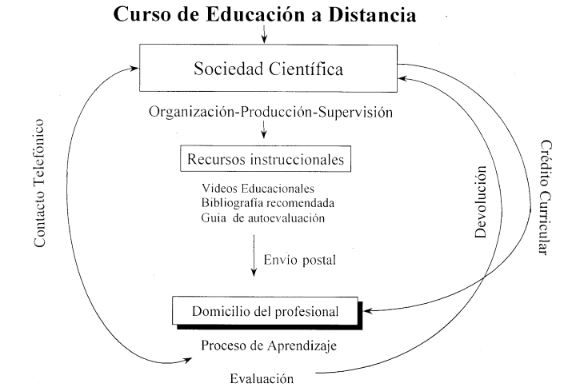
Continuous medical education is main goal of scientist societies. Because of the diverse difficulties in getting knowledge from the centers of education, the Argentine Society of Cardiology begun a program of Distance Education. Our objective is to analyze the population that took part of this new educational modality during the first year.
Material and method
The data obtained were: age, gender, nationality, address, speciality, years since graduation, university of graduation, medical activity, antecedent of medical residence. The program consisted of video-cassettes that were sent to the physicians' address. Statistical analysis: unpaired "t" test for independent samples, chisquare test with Yates' correction and multivariate regression logistic analysis were done.
Results
The population reached 459 physicians. Middle age 42.9 ± 7.9 years, 67% between 30 and 49 years. More than 10 years since graduation was referred by 83% of the population and 84% attended public or private hospitals. Forty two percent was living at Federal District and surrounding areas and other cities 58%. Antecedent of medical residence was referred by 58%, it was more prevalent in those who were living outside the Federal District and was statistically significant in the population under 42 years (p < 0.01). The multivariate regression logistic analysis confirmed the association between the age (p<0.0001) and the address referred (p < 0.03) with ex-residence condition.
Conclusions
The population under this educational modality is characterized by several years since graduation, showing difficulties in relation to distance and lack of time to attend to post-graduate courses. The previous post-graduate education and medical activity mark a methodology to continuous education.
Downloads
Published
Issue
Section
License
Copyright (c) 2026 Argentine Journal of Cardiology

This work is licensed under a Creative Commons Attribution-NonCommercial-ShareAlike 4.0 International License.